some absolutes or almost always cases include the following:
Scombroid is caused by ingestion of preformed histamine on skin of fish.
Postcardiac Arrest Syndrome: Controlled Reoxygenation
Massive Pulmonary Embolism and Response to Fluids and Mechanical Ventilation
Massive pulmonary embolism leads to acute pulmonary hypertension and right ventricular overload. This leads to release of troponin and a "bowing" of the interventricular septum on echocardiography. Deviation of the septum then leads to a decrease in left-sided cardiac output.
A few interesting clinical pearls:
Elderly patients have slightly lower body temperatures than younger adults, and as a result it has been suggested that "fever" be defined as anything > 99 degrees F. One study found that by lowering the definition to this number improved the sensitivity and specificity to 83% and 89%, respectively.
from Hals G. Common diagnoses become difficult diagnoses when geriatric patients visit the emergency department, part I. Emergency Medicine Reports 2010;31(9):101-110.
study referred to: Castle SC, et al. Fever response in elderly nursing home residents: are the older truly colder? J Am Geriatric Soc 1991;39:853-857.
Osteomyelitis:
Hyperpronation: This reduction technique for a nursemaid's elbow (radial head subluxation) has been found to have better first attempt success than classic supination/flexion technique. (Pediatrics July '98). Support the elbow with a finger on the radial head, and forcefully hyperpronate.
Stroke strikes F.A.S.T. and must be recognized quickly for optimized management.
The following Face, Arms, Speech test, known as F.A.S.T., is an easy and quick bedside teaching tool that can be used to spread awareness about how to recognize and respond to stroke symptoms:
F = Ask person to smile. Does one side of face droop down?
A = Ask person to raise both arms. Does one arm drift downward?
S = Ask person to say a simple phrase. Does speech sound slurred or strange?
T = If any of the above findings are observed, it's time to call 911 immediately.
A single episode of hypotension portends a worse outcome for septic patients. The restrospective analysis by Marchick et al of 700 patients showed that mortality was 10% vs 3.6% for septic patients whose SBP dropped below 100 even once. It was also noted that the lower the SBP, the worse the in-hospital mortality.
So, not only do we need to remember to watch blood pressure closely for head-injured patients, but for septic patients as well!
We all know how difficult it can be to teach in the ED when it is busy. So how do the experts do it when there is so little time?
Just a few considerations that might make your teaching more effective and easier to do when it is busy:
Elderly patients should be considered immunocompromised for several reasons:
1. T cell function and reduced cellular immunity occur as we get older.
2. B cell antibody production decreases.
3. Host defenses against infection are reduced with aging, such as reduced circulation and thinning skin.
4. Miscellaneous factors, such as malnutrition and co-existing illnesses contribute to increased risk of infection as well.
[Good reference and suggested reading: Hals G. Common diagnoses become difficult diagnoses when geriatric patients visit the emergency department: Part I. Emergency Medicine Reports 2010;31(9):103-111.]
Radial Head Fractures:
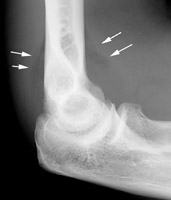
Radial head fractures can often be difficult to visualize on plain films especialing Mason Type 1 fractures (see prior pearl on classification system) which are nondisplaced. Often the only sign of a fracture will be a posterior fat pad sign which is always considered to be pathologic. The posterior fat pad lies outside the synovium of the elbow joint and is normally hidden in the fossa of the distal humerus preventing it from being seen on lateral films of a normal elbow. Trauma to the elbow that results in a intraarticular fracture (typically a radial head fracture) produces an intra-articular hemorrhage that distends the synovium and displaces the fat out of the fossa, producing the typical triangular radiolucent shadow posterior to the distal end of the humerus.
Once you've made the presumptive diagnosis of cerebral edema in Pediatric DKA (refer to part 1), here's what's next:
Mortality from cerebral edema in DKA is 20-25%, and 15-35% of survivors have permanent disability.
The best strategy is to do your best to avoid cerebral edema in the first place, but if you do recognize it, this is a clinical diagnosis, and you should not delay treatment for radiographic studies.
We are all familiar with the classic ECG abnormalities caused by the sodium channel blocking properties of tricyclic antidepressants (QRS interval widening, R wave in aVR, S wave in I and aVL, and rightward deviation in terminal 40 msec of QRS). Here are some other medications that also block cardiac sodium channels in a similar manner:
-- Hypertension
-- Diabetes
-- Atrial Fibrillation
-- Hypercholesterolemia
-- Physical Inactivity
-- Tobacco Use
-- Alcohol Use
-- Obesity
PRBC Transfusions in Neurocritical Care
Some considerations in the patient with a penetrating vascular injury (gunshot, stab):
The most likely considerations for a regular, narrow complex tachycardia are sinus tachycardia (ST), atrial flutter with 2:1 conduction, and supraventricular tachycardia (SVT, a generic terms that encompasses a few remaining rhythms originating above the ventricle). Atrial flutter is diagnosed when one sees atrial beats at a rate of 250-350/minute.
The distinction between ST and SVT can be difficult at very rapid rates. Here are a few clues that may help in this distinction:
1. Generally the maximal sinus rate that a patient produces will be 220-age. That means that a 20 year old can possibly have a ST up to 200 beats/min, but a 70 year old can only have a ST has fast as 150 beats/min. Rates that exceed that simple formula are extremely unlikely to be ST.
2. If the rate varies with respiration, with positional changes, with relaxation, or with fluid administration, these all favor ST.
3. If the rate reduces slowly, it favors ST. SVT, on the other hand, tends to "break" suddenly.
4. SVT generally will either have no P-waves visible or there may be P-waves just after the QRS complexes. These are referred to as retrograde Ps.
5. History, history, history. Is there a reason for tachycardia, for example a history consistent with dehydration or anxiety? That favors ST. If the patient reports palpitations or other symptoms that were of abrupt onset, that favors SVT.
6. Valsalva maneuvers may gently slow down ST but will either not affect SVT or will abruptly break the SVT....SVT shouldn't gently slow down.
Conservative Treatment of Back Pain:
Muscle relaxanats and benzodiazipnes are often used in the non-operative management of sciatica and non-specific low back pain. In fact, a 2003 Cochrane review concluded that muslce relaxanats were effective in the management of non-specific low back pain. However, a recent analysis of randomized trials reported little efficacy or only minor benefits with the use of benzodiazapines in treatment of low back pain.
A recent prospective, randomized, placebo-controlled, double-blinded trial conducted in Germany that enrolled a total of 60 patients found that the use of diazepam was equivilant to placebo in the reduction of distance of referred pain at day 7 of treatment. Diazepam was also noted on average to increase the length of stay of those patients hospitalized by 2 days (median hospital days of 8 for placebo versus 10 for diazepam), and the probablility of pain reduction on a visual analog scale by more than 50% was twice as high in the placebo group (p< 0.0015). Placebo reduced the patients pain more than diazepam.
Though the sample size was small; this study should really make one reevaluate the use of diazepam in the treatment of back pain. Early movement and discouraging bed rest have been associated with decreased back pain, so one mechanism by which benzodiazepines may make things work is by causing enough sedation to prevent early movement.