Previous  |  1 |  ... |  173 |  174 |  175 |  176 |  177 |  178 |  179 |  180 |  181 |  182 |  183 |  ... |  230 |  Next

Title: RIFLE Criteria for Renal Failure

Category: Critical Care

Posted: 6/22/2010 by Evadne Marcolini, MD (Updated: 3/4/2026)

Acute renal failure occurs in 1-25% of critically ill patients, with an associated mortality of 28 - 90%. 

The RIFLE Criteria represent the first consensus definition of acute renal failure used to classify critically ill patients as to their kidney function.  Notably, we use the worst possible classification according to the criteria, which measures either serum creatinine, urine output or both. 

Show References

Attachments


Title: nitrite test for UTI in elderly

Category: Geriatrics

Keywords: nitritie, infections, elderly, geriatric (PubMed Search)

Posted: 6/20/2010 by Amal Mattu, MD

The nitrite test on urine dipstick is commonly used for diagnosis of UTI. However, the test is only reliable in those bacteria that convert nitrates to nitrites, which primarily includes enterobaceriaceae. However, elderly patients often develop UTIs with Staph saprophyticus, pseudomonas, and enterococcus, none of which produce positive nitrites on dipstick testing. The takeaway point here is very simply....don't assume you've excluded UTI (esp. in elderly populations) just because the nitrite test is negative.

reference: Anderson RS, Liang SY. Infections in the elderly. Critical Decisions in Emergency Medicine, April 2010.

Show References


Title: Toxicodendron dermatitis

Category: Dermatology

Keywords: Toxicodendron dermatitis, treatment (PubMed Search)

Posted: 6/19/2010 by Michael Bond, MD (Updated: 3/4/2026)

Toxicodendron dermatitis:

This is the contact dermatitis caused by the plant genus Toxicodendronm, better known as Poison Ivy.  Here are some types to prevent the dermatitis and how to treat it:

  1. Barrier products like Ivy Block® are on the market that go on like suntan lotion and provides a protective barrier on your skin that prevents the plants urushoil, the toxin responsible for the dermatitis, from making contact with your skin. This can help prevent the dermatitis if you are able to wash the oils off.
  2. Most soaps can not remove urushiol and may actually increase its spread. Several products are on the market, one being Zanfel® , that are a little more effective than water in removing the urushiol which can help to minimize the dermatitis and its spread.
  3. The mainstay of treatment is systemic steroids.  This condition does not do well with a short (5 day) burst therapy and patients will typically get a rebound dermatitis when the burst is complete.  Patients should be placed on a 14 day steroid taper.

Show References


Title: Use of Nicardipine for Intracranial Hemorrhage and Related Hypertensive Emergency

Category: Neurology

Keywords: nicardipine, calcium channelblocker, hypertensive emergency, intracranial hemorrhage, hypertension, stroke (PubMed Search)

Posted: 6/16/2010 by Aisha Liferidge, MD (Updated: 3/4/2026)


Show References


Title: Hypotension and MV

Category: Critical Care

Posted: 6/15/2010 by Mike Winters, MBA, MD (Updated: 3/4/2026)

Hypotension after intubation and initiation of mechanical ventilation

Show References


Title: TSH test

Category: Misc

Posted: 6/14/2010 by Rob Rogers, MD (Updated: 3/4/2026)


Submitted on behalf of Dr. Michael Abraham

Thyrotropin (TSH) 


Show References


Title: pericardial effusions and electrocardiography

Category: Cardiology

Keywords: pericardial effusion, tamponade (PubMed Search)

Posted: 6/13/2010 by Amal Mattu, MD (Updated: 3/4/2026)

Pericardial tamponade is a physiological diagnosis, not an ECG diagnosis. At best, the ECG can suggest the presence of large pericardial effusions--look for the combination of low voltage, tachycardia, and electrical alternans.

Be aware, however, that electrical alternans is only present in < 1/3 of patients with large pericardial effusions. Although it is "classic" and always seems to show up on board exams, in the textbooks, and in lectures, electrical alternans in not a consistent finding in patients with large effusions or tamponade. 


Title: Calcaneus Fractures

Category: Orthopedics

Keywords: Calcaneus Fracture, Bohler Angle (PubMed Search)

Posted: 6/13/2010 by Michael Bond, MD

Calcaneus Fractures:

Calcaneus fractures can easily be missed on plain films and the true extent of the injury might not be appreciated until a CT is done.  However, you can increase your change of picking up a calcaneal fracture by evaluating Bohler's Angle. 

Lateral radiographs of the foot are needed to evaluate the Bohler angle.  This is the angle made by drawing a line from anterior process of the calcaneus to the peak of the posterior articular surface and a second one drawn  from the peak of the posterior articular surface to the peak of the posterior tuberosity. (See Picture) The average angle is 25-40°. Angles less than 25' are strongly suggestive of a fracture and the patient should probably get a CT of their foot if there is clinical suspicion.
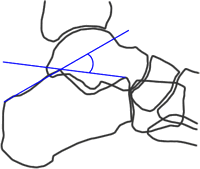
Bohler's Angle

Show References


Title: Pediatric Burns, Part I

Category: Pediatrics

Keywords: Pediatric Burns, Fire, Injury, Burn Injuries, Sage Diagram, TBSA (PubMed Search)

Posted: 6/11/2010 by Adam Friedlander, MD (Updated: 3/4/2026)

Current American Burn Association guidelines state that any child with a greater than 10% total body surface area (TBSA) burn should be admitted to a center capable of caring for pediatric burns, rather than being discharged after wound management.  However, physician use of TBSA% estimation techniques is variable.  An excellent free tool for estimating TBSA is available online, allows for automatic weight based calculation, and allows printing of your diagram.  The diagram is available at http://www.sagediagram.com/.  More to come...

Show References


Title: Physostigmine for Anticholinergic Poisoning

Category: Toxicology

Keywords: physostigmine, anticholinergic (PubMed Search)

Posted: 6/10/2010 by Bryan Hayes, PharmD (Updated: 3/4/2026)

Physostigmine has been used extensively in the fields of anesthesiology and emergency medicine.  The only use of physostigmine with sound scientific support is for the management of patients with an anticholinergic syndrome, particularly those without cardiovascular compromise who have an agitated delirium.  In this population, physostigmine has an excellent risk-to-benefit profile.


Title: Tips for Increasing CSF Flow During Lumbar Puncture

Category: Neurology

Keywords: lumbar puncture, LP, spinal tap (PubMed Search)

Posted: 6/9/2010 by Aisha Liferidge, MD (Updated: 3/4/2026)

Once you've punctured the spinal canal space during lumbar puncture, the following tips can be used to improve the rate of cerebrospinal fluid (CSF) flow, should it be suboptimal:

  1. Ask the patient to cough or bear down as in the Valsalva maneuver.
  2. Ask an assistant to intermittently press on patient's abdomen.
  3. Turn the spinal needle 90 degrees such that the bevel is cephalad.
  4. Use a larger diameter spinal needle (increases risk of post-lumbar puncture headache).


Title: Platelet Transfusions in the Critically Ill

Category: Critical Care

Posted: 6/8/2010 by Mike Winters, MBA, MD (Updated: 3/4/2026)

Platelet Transfusions in the Critically Ill

Show References


Title: Got Lytics?

Category: Vascular

Keywords: Pulmonary Embolism (PubMed Search)

Posted: 6/7/2010 by Rob Rogers, MD (Updated: 3/4/2026)

Thrombolytic Therapy for Pulmonary Embolism

Current, FDA-approved thrombolytic therapy for PE:


Title: appendicitis misdiagnosis in the elderly

Category: Geriatrics

Keywords: geriatrics, elderly, appendicitis (PubMed Search)

Posted: 6/7/2010 by Amal Mattu, MD (Updated: 3/4/2026)

Up to 25% of elderly patients with appendicitis are initially sent home from the ED, an indication of the high misdiagnosis rate for appendicitis in the elderly population. Why are elderly patients so often misdiagnosed when they have appendicitis? The answer is simple....they present very atypically.


Expect the atypical in elderly patients!
 

Show References


Title: Wound Care

Category: Orthopedics

Keywords: Wound Care, Antiseptics (PubMed Search)

Posted: 6/5/2010 by Michael Bond, MD

Wound Care:

Patients and many providers want to irrigate or wash a wound with an antiseptic solution in order to decrease the risk of infection.  Most studies have shown that irrigation whether with tap water or sterile water is effective enough in reducing bacterial counts in a wound so does adding an antiseptic solution offer any additional benefit.

It turns out that hydrogen peroxide, and iodine based solutions can actually hinder wound healing as they causes delays in the migration and proliferation of fibroblasts at concentrations that are not even bactericidal.  Chlorhexidine, and silver containing antiseptics [i.e.: silver sulfadiazine and silver nitrate] are bactericidal at concentrations that do not affect fibroblasts.

So in the end, if you feel the need to use an antiseptic, use chlorhexidine or a silver containing antiseptic.  The use of hydrogen peroxide and iodine based solutions should be abandoned as they are not even bactericidal at concentrations that have profound affects on the fibroblasts.

Show References


Title: Deadly in a Single Dose

Category: Toxicology

Keywords: pediatrics, toxicology, antidepressant, antimalarial, antipsychotic, calcium channel, aspirin (PubMed Search)

Posted: 6/4/2010 by Ellen Lemkin, MD, PharmD (Updated: 3/4/2026)

There are a several classes of medications that can kill a toddler with a single dose. Toddlers are particularly susceptible due to their low weights and propensity to place everything in their mouths.


1. Calcium channel blockers
2. Camphor-containing rubs
3. Opioids/opiates
4. Oil of wintergreen/ aspirin
5. Cyclic antidepressants
6. Topical blood pressure patches (clonidine)
7. Eye drops and nasal sprays (oxymetazoline)
8. Sulfonylureas
9. Antimalarial drugs (cloroquine)

Show References


Title: Optic Neuritis: Clinical Findings and Significance

Category: Neurology

Keywords: optic neuritis, multiple sclerosis, blindness, visual abnormality (PubMed Search)

Posted: 6/2/2010 by Aisha Liferidge, MD (Updated: 3/4/2026)


Show References


Title: Neuroleptic Malignant Syndrome

Category: Critical Care

Posted: 6/1/2010 by Evadne Marcolini, MD

Neuroleptic malignant syndrome (NMS), which is similar in symptomatology to malignant hyperthermia (MH), is characterized by the following:
1) increased body temperature
2) muscle rigidity
3) altered mental status
4) autonomic instability
 
The difference between NMS and MH is the etiology.  NMS is caused by the following medications:
Antipsychotics (haldol, phenothiazines, clozapine, olanzapine, risperadone)
Antiemetics (metoclopramide, droperidol, prochlorperazine)
CNS stimulants (amphetamines, cocaine)
Other (lithium, TCA overdose)
 
NMS can also be cause by disconinuation of dopaminergic drugs (amantadine, bromocriptine, levodopa)
 
Symptoms can begin to appear 24 to 72 hours after the onset of drug therapy, and are usually gradual. 
 
Management includes checking CK level (>1000 distinguishes NMS from sepsis), immediate removal of the offending drug, and consideration of Dantrolene or Bromocriptine.

Show References


Title: infections in the elderly part II

Category: Geriatrics

Keywords: fever, elderly, geriatrics (PubMed Search)

Posted: 5/30/2010 by Amal Mattu, MD (Updated: 3/4/2026)


Fever is less common in infectious states in the elderly than in young patients. However, in contrast to younger patients, when an elderly patient does have a fever it is much more likely to be associated with a serious bacterial infection. It has been estimated that the source of fever in elderly ED patients is viral in only 5% of cases.


[from Hals G. Common diagnoses become difficult diagnoses when geriatric patients visit the emergency department, part I. Emergency Medicine Reports 2010;31(9):101-110.]


Title: Septic Arthitis and BioMarkers

Category: Orthopedics

Keywords: Septic Arthritis (PubMed Search)

Posted: 5/29/2010 by Michael Bond, MD (Updated: 3/4/2026)

Septic Arthritis versus Arthritis:

Though CRP and ESR levels are significantly higher in patients that have septic arthritis, a 1998 study showed that there is extensive overlap between patients with septic arthritis  crystal assoicated arthritis that both CRP and ESR have low sensitivity, specificity and predictive values.  Peripherial WBC counts did not differ between the two disease processes..

The morale of the story:  If you are suspecting septic arthritis you need to  perform an arthorcentesis to analysis the synovial fluid.  Systemic biomarkers can not support one diagnosis over the other.

Show References


Previous  |  1 |  ... |  173 |  174 |  175 |  176 |  177 |  178 |  179 |  180 |  181 |  182 |  183 |  ... |  230 |  Next