Critical Care billing is time dependent and includes all time spent caring for and coordinating (i.e.: reviewing records, talking to consultants or family) the care of the patient except for the time spent doing separately billable procedures (i.e. central line, CPR, etc). The following procedures taken from the ACEP website are included in the Critical Care code so the time spent doing these procedures should BE included in your total Critical Care time .
They are :
ACADEMIC MEDICINE CAVEAT: For the reporting of time-based services, such as critical care or moderate sedation, the teaching physician must be directly present during the entire reported time period.
Congenital hypothyroidism (CH) is almost uniformly identified before symptoms develop because of newborn screening. Though this problem will rarely present to the Emergency Department, it is not uncommon for parents with poor access to care to present to EDs after being notified of an abnormal screen. Here is what you need to know:
So:
When you draw a urine toxicology screen it can mislead more often than help you. Here is a quick list of the test followed by some medications that cause false positives - when in doubt, call your lab to find out specifics since results will vary lab to lab:
TCA - diphenhydramine, carbamazepine, cyclobenzaprine (side note: TCA screen should never be used to determine TCA toxicity, your ECG and physical exam should be enough to determine if the patient is toxic from TCA
Cocaine - the most accurate test on the screen, positive for up to 5 days
PCP - dextromethorphan and ketamine can turn it positive
Amphetamines - pseudoephedrine, ephedrine, phenylephrine and many other OTC cough decongestants can as well, the worst screening test with the largest number of false positives
-- Deja' vu (feeling of familiarity) -- Jamais vu (feeling of unfamiliarity)
-- Specific or single set of memories -- Amnesia
-- Auditory -- Gustatory -- Visual -- Disphoric -- Euphoric
Warfarin and ICH
A recent study of nearly 800 patients with chest pain evaluated symptoms and signs that are most predictive of ruling in for ACS. The following characteristics made acute MI more likely (likelihood ratios in parentheses): observed diaphoresis (5.18), central location of chest pain (3.29), associated vomiting (3.50), radiation of the pain to bilateral arms (2.69), and radiation of pain to the right arm (2.23).
As we've said before, if your patient sweats, it ought to make YOU sweat!
[BodyR, et al. Resuscitation 2010;81:281-286.]
Knee Dislocation:
According to the Food Allergy and Anaphylaxis Network, the eight most common food allergies, which account for 90% of the food allergies in the U.S., are: dairy, soy, wheat, shellfish, fish, peanut, tree nut, and egg.
Several medications are formulated with these ingredients and should be avoided in patients with reported allergies.
Primary Intracranial hemorrhage is associated with the following risk factors:
Common causes of secondary ICH are as follows:
The question of how to address elevated blood pressure in spontaneous intracranial hemorrhage has been debated. High blood pressure may cause hematoma expansion, but this has not been proven. Lowering blood pressure may help reduce neurologic deterioration, but this has also not been proven in the literature.
The AHA recommended guidelines for blood pressure management in spontaneous ICH are as follows:
If SBP>200 or MAP>150, consider aggressive reduction of BP with continuous IV infusion, monitoring BP every 5 minutes
If SBP>180 or MAP>130, with evidence or suspicion of elevated ICP, consider monitoring ICP and reducing BP using intermittent or continuous IV medications to keep CPP>60 to 80
If SBP>180 or MAP>130 without evidence or suspicion of elevated ICP, then consider a modest reduction of BP (MAP of 110 or targeted SBP 160/90) using intermittent or continuous IV medications, monitoring BP every 15 minutes
Splenic Artery Aneurysm (SAA)
Ever scanned someone and the report says "incidental note of a splenic artery aneurysm"? Well, if it hasn't happened yet, it will sooner or later. This type of aneurysm isn't that rare and with the number of abdominal CTs we order we are bound to see this in clinical practice.
Some important points to remember about SAA:
Major and minor clinical prognostic predictors for pericarditis have been described as follows:
Major: fever > 38 degrees C, subacute onset, large effusion, tamponade, lack of response to aspirin or NSAIDs after at least 1 week of therapy
Minor: myopericarditis, immunodepression, trauma, oral anticoagulant therapy
Patients with any of these criteria [major or minor] should strongly be considered for admission. In the absence of these factors, studies show that patients managed as outpatients do well.
[Imazio M, Spodick DH, Brucato A, et al. Controversial issues in the management of pericardial diseases. Circulation 2010;121:916-928.]
Pelligrini-Stieda Lesion:
A Pelligrini-Stieda lesion is shown in the radiograph below. This lesion was originally described in 1905, and is associated with a tear of the Medial Collateral Ligament. Heterotrophic calcification forms causing chronic pain, which typically needs to be surgically excised.
So for the students out there, it is possible to diagnosis an MCL tear on plain radiographs. Just not very often.

| Cutting Edge | Old School |
| Gastric Lavage | |
| Hyperinsulinemia and Euglycemia | Supportive care, glucagon for beta blocker overdoses |
| Intralipid administration | Supportive care for anesthetic overdoses, TCAs, and other lipid soluble agents |
| Low dose or NO narcan | High dose narcan for opoid overdoses |
| Checking salicylates and tylenol levels for overdose | Tox screens for everyone |
Ventilating the Patient with Traumatic Brain Injury
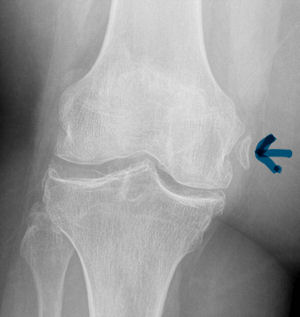
The Segond Fracture:
An benign appearing avulsion fracture of the lateral tibeal plateau that is marker for more significant injuries such as:
If this avulsion fracture is seen consider immobilzing the patients knee until they can follow up with Orthopedics and/or get an MRI to determine if additional injuries are present.

Precedex (Dexmedetomidine) - Great for pediatric imaging procedures
Alpha-2 agonist with sedative properties
No analgesic effect alone, but shown to decrease the amount of opioids required for a painful procedure
Benefits pts go to sleep and awake in a more natural state. Caregivers tend to prefer this as opposed to other sedatives. Short recovery time- about 30 minutes
Adverse effects include bradycardia and hypotension. Not recommended in any child with cardiac abnormalities. Paradoxical hypertension with loading dose has also been observed
Effective for MRI or CT scans at loading doses of 2mcg/kg over ten minutes, then maintenance of 1mcg/kg/hr
Residents can gain experience with Precedex with Peds sedation on M,W,F mornings with sedation team, contact me to arrange a time for you to participate.