The most recent AHA guidelines for goal blood pressure after return of spontaneous circulation (ROSC) post-cardiac arrest recommend a definite mean arterial pressure (MAP) goal of > 65 mmHg.1 There is no definitive data to recommend a higher specific goal, but there is some evidence to indicate that maintaining higher MAPs may be associated with better neurologic outcomes.2
A recently published prospective, observational, multicenter cohort study looked at neurologic outcomes corresponding to different MAPs maintained in the initial 6 hours post-cardiac arrest.3
Findings:
1. Compared to lower blood pressures (MAPs 70-90 mmHg), the cohort with MAPs > 90 mmHg had:
2. The association between MAP > 90 mmHg and good neurologic outcome was stronger among patients with a previous diagnosis of hypertension, and persisted regardless of initial rhythm, use of vasopressors, or whether the cardiac arrest occured in or out of hospital.
3. There was a dose-response increase in probability of good neurologic outcome among all MAP ranges above 90 mmHg, with MAP >110 mmHg having the strongest association with good neurologic outcome at hospital discharge.
Note: The results of a separate trial, the Neuroprotect post-CA trial, comparing MAPs 85-100 mmHg to the currently recommended MAP goal of >65 mmHg, are pending.4
Bottom Line: As per current AHA guidelines, actively avoid hypotension, and consider use of vasopressor if needed to maintain MAPs > 90 mmHg in your comatose patients post-cardiac arrest, especially those with a preexisting diagnosis of hypertension.
The most common methods of medication administration in the emergency department are oral, intravenous (IV), and intramuscular (IM). If the oral route is not available, if IV/IM are not necessary, or if obtaining IV access is challenging, intranasal (IN) medication delivery is a reasonable alternative. More concentrated products are preferred and a volume of 1 mL or less per nostril should be utilized. Below is a table of the commonly used medications used via the IN route.
| Drug | Concentration | Indication | IN Dose | Time to Peak Effect | Adverse Events |
| Fentanyl | 50 mcg/mL | Analgesia | 0.5-2 mcg/kg | 5 min | Nasal irritation, rhinitis, headache |
| Ketamine | 100 mg/mL | Analgesia, Agitation, Sedation | 3-6 mg/kg | 5-10 min | Poor taste, HTN, hypersalivation, agitation, emergence reaction |
| Lorazepam | 2 mg/mL | Agitation, Seizures | 0.1 mg/kg Max: 4 mg | 30 min | Poor taste, lacrimation, nasal/throat irritation |
| Midazolam | 5 mg/mL | Agitation, Sedation, Seizures | 0.1-0.4 mg/kg Max: 10 mg | 5-10 min | Same as lorazepam |
| Naloxone | 1 mg/mL | Opioid Reversal | 0.1 mg/kg Usual dose: 0.4-2 mg | 1-5 min | N/V, headache, withdrawal symptoms |
Concussion Management in Children
What are the predictors of prolonged recovery of concussion in children?
Female sex, age greater than 13, prior physician diagnosis of migraine, prior concussion with symptoms lasting longer than 1 week, history of multiple concussions, headache, sensitivity to noise, dizziness, fatigue, answering questions slowly and four or more errors on tandem stance testing.
Age: As compared to younger children, adolescents have a greater number of and more severe postconcussive symptoms. They take longer to recover and return to school and sport.
Subjects: Math tends to pose greater problems followed by reading/language, arts, sciences and social studies.
Computer testing: The widespread use of computer neuropsychological testing is not recommended in children and adolescents. This is due to issues with reliability over time and insufficient evidence of both diagnostic and prognostic value. When used, reference to normative data should be done with caution. Testing should also NOT be used in isolation in concussion diagnosis and management.
Manifestations due to neurosyphilis present as one of 3 categories: stroke due to arteritis, masses in the brain (granulomata), and chronic meningitis.
Although serum VDRL/TPPA tests will be positive in almost all patients, it’s important to remember that the diagnosis requires the presence of ALL of the following criteria:
1. positive treponemal (e.g. FTA-ABS, TP-PA) AND nontreponemal (e.g. VDRL, RPR) serum test results
2. positive CSF VDRL OR positive CSF FTA-ABS test result
3. one CSF laboratory test abnormality, such as pleocytosis (cell count >20/μL) or high protein level (>0.5 g/L)
4. clinical symptoms
This is important because the treatment of neurosyphilis is distinctly different from other forms, as it requires admission for IV antibiotics for at least 10 days.
Bonus Pearl: CSF RPR is unreliable as it is more likely to be falsely positive than other specific CSF testing.
Historically, the C-reactive protein (CRP) has been used in the assessment of the febrile child and is the only biomarker recommended by the National Institute for Health and Care Excellence (NICE).
CRP increases 4-6 hours after the onset of inflammation, doubling every 8 hours and peaking at 36-50 hours. It rapidly decreases once the inflammation has resolved.
An elevated CRP alone is not conclusive of a serious bacterial infection (SBI).
A CRP >75 mg/L increased the relative risk of SBI by 5.4.
A CRP <20 mg/L decreased the risk of SBI, but there was still a small subset of children where SBI was present.
In infants < 3 months initial CRP measurements are poorly accurate, but when trended may be useful in deciding when to stop antibiotics (rather then when to start them). A normalizing CRP demonstrated a 100% negative predictive value for excluding invasive bacterial infection.
Bottom line:
CRP is not a rule in/rule out test
CRP is not helpful in diagnosing SBI, but serial measurements may be useful in monitoring response to treatment
CRP has a limited role in well appearing children older than 3 months
CHS Treatment:
Bottom line: Patient education should be provided on the paradoxical and recurrent nature of the symptoms of CHS to discourage relapse of use often stemming from false preception of beneficial effects of cannabis on nausea.
You have successfully diagnosed a concussion, explained everything to the parents, closed the encounter, reached for the doorknob and….
“What about school?”
An athlete should not return to play until they have successfully returned to school
Several studies have demonstrated that intense cognitive stimulation and intense intellectual stimulation result in worsening symptoms
-school work, TV, videogames, texting
Attempt to limit cognitive activity to the point where it begins to reproduce or worsen symptoms!
Step 1: 24 to 48 hours of rest
Step 2: Daily at home activities that do not increase symptoms. Starting with 5 – 10 minutes and gradually build up to a goal of tolerating 30 minutes of cognitive activity without worsening symptoms.
Home work, reading assignments, other cognitive activities
Step 3: Attempt Return to school (will not be completely symptoms free!) with either part time, partial days, or with extended breaks. Goal of tolerating an entire school day without symptoms.
Most students recover fully within 4 weeks and adjustments can then be discontinued. Others with ongoing symptoms may require ongoing academic modifications (extra time for tests, papers, etc).
Suggested examples of adjustments: Shortened days, 15 minute break for every 30 minutes of instruction, providing class notes, tutoring, decreasing course expectations, decreasing exposure to classes which exacerbate symptoms, no computer work, untimed tests and quizzes, lunch in a quiet place.
Does using a combination of aspirin and clopidogrel decrease your patient’s risk of recurrent stroke after a minor ischemic stroke or high risk TIA event?
Bottom Line: The use of DAPT in minor ischemic stroke and high risk TIA reduces the risk of recurrent stroke. However, the duration of DAPT may affect the risk of major hemorrhage.
We know that high flow nasal cannula is an option in the management of acute hypoxic respiratory failure without hypercapnea. A newer iteration of high flow, "high velocity nasal insufflation" (HVNI), may be up-and-coming.
According to its makers (Vapotherm), it is reported to work mainly by using smaller bore nasal cannulae that deliver the same flows at higher velocities, thereby more rapidly and repeatedly clearing dead space, facilitating gas exchange and potentially offering ventilatory support.
In an industry-sponsored non-inferiority study published earlier this year:
Bottom Line:
The availability of a nasal cannula that helps with CO2 clearance would be great, and an option for patients who can't tolerate the face-mask of NPPV would be even better.
HVNI requires more investigation with better studies and external validation before it can really be considered noninferior to NPPV, but it certainly is interesting.
Clonidine is an alpha-2 agonist commonly used to treat hypertension. Clonidine can also be used to mitigate symptoms of opioid withdrawal as it easily crosses the blood brain barrier and reduces sympathetic effects.
When using clonidine for acute withdrawal or blood pressure control, oral tablets are the preferred route. Clonidine transdermal patches have slow absorption and take 2-3 days for the effect to be seen. Once removed, clonidine patches can provide therapeutic levels for up to 20 hours.
Bottom Line: If clonidine is needed acutely for your patient, select oral tablets and titrate to effect.
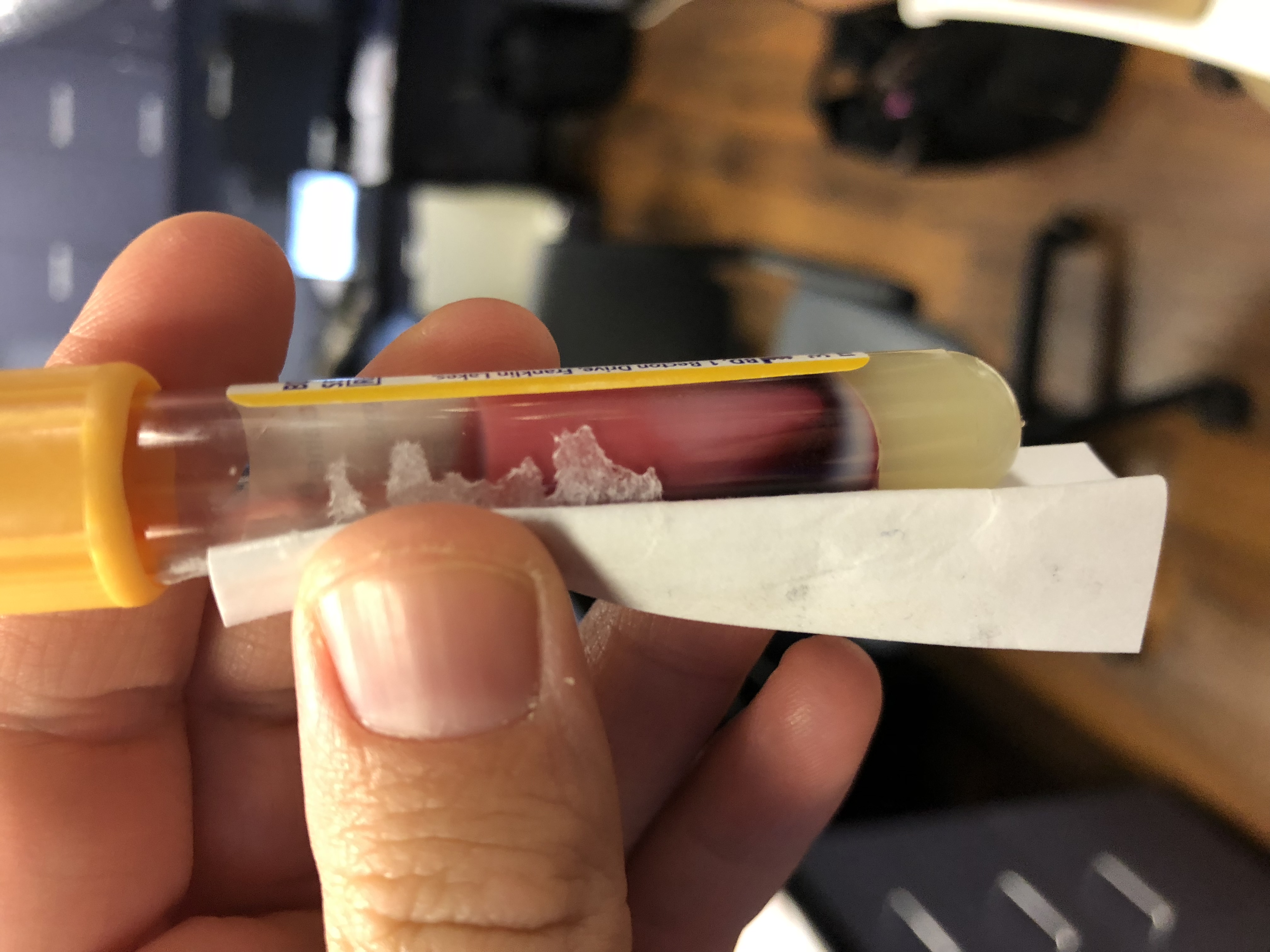
33 y/o M with PMH of ETOH induced pancreatitis presents with epigastic/RUQ pain & N/V after drinking last night, per patient his usual “pancreas pain”. The nurse shows you his blood tubes because they look “milky”. Lipase 1200, Ca 6.8.

What lab test would you add?
25yo baseball pitcher presents with medial elbow pain. He felt a painful “pop” and could not continue to throw (due to loss of speed and control). Mild paresethesias in 4th and 5th digits.
What physical examination maneuvers can you do at the bedside to assist in the diagnosis?
Exam opposite elbow first to establish baseline and to assist patient relaxation and understanding.
Flexing elbow to 20 to 30 degrees unlocks the olecranon
https://www.youtube.com/watch?v=KXQxH0UTn-8
https://www.youtube.com/watch?v=4sa9goJ4afs
or
https://www.youtube.com/watch?v=SwigwaZxBXE
https://www.youtube.com/watch?v=OnkkHpG3Dqg
Originally described a Dr. West in 1841 – it is a rare (~1200 cases annually) seizure disorder in young kids, generally less than 1 year old. Very subtle appearance, often with only bending forward or ‘jerking’ of the extremities as opposed to Brief Resolved Unexplained Event (BRUE) or tonic-clonic in description. The spasms can be thought of as a syndrome, where 70% of those have an undiagnosed rare metabolic/genetic disease.
A prompt evaluation, including labs, EEG, MRI, metabolic and genetic studies is vital in helping to establish a diagnosis which can have a profound impact on the patients prognosis. Examples might include Tuberous Sclerosis, Pyridoxine Dependent Seizures among over 50 others.
Bottom line: In pediatric patients less than 1 year old who present to the Emergency Department with a description of spasm-like episodes, consider Infantile Spasms on the differential, and consult your friendly neighborhood Pediatric Neurologist for help in determining a proper disposition.
A 19 year old male presents confused and very agitated complaining of seeing things and stomach pain. His friends report he ingested a naturally occurring plant to get high a few hours ago but is having a "bad trip". His physical exam :
Temp 100.3, HR 120, RR 14, BP 130/88. Pulse Ox 98%.
Skin: Dry, hot , flushed
HEENT: Marked mydriasis 6mm
Lungs: Clear
Heart: Tachycardic
Abdomen: Distended tender suprapubic with absent bowel sounds,
Neuro: Extremely agitated pacing, no muscular rigidity.
What has he ingested and what is the treatment?
Sedating Mechanically Ventilated Patients
The Centers for Disease Control and Prevention recently released guidelines on the diagnosis and management of mild traumatic brain injury (mTBI**) among children. From 2005-2009, children made almost 3 million ED visits for mTBI. Based on a systemic review of the literature, the guideline includes 19 sets of recommendations on the diagnosis, prognosis, and management/treatment of pediatric mTBI.
Key Recommendations:
1. Do not routinely image patients to diagnose mTBI (utilize clinical decision rules to identify children at low risk and high risk for intracranial injury (ICI), e.g. PECARN)
2. Use validated, age-appropriate symptoms scales to diagnose mTBI
3. Assess evidence-based risk factors for prolonged recovery. No single factor is strongly predictive of outcome.
4. Provide patients with instructions on return to activity customized with their symptoms (see CDC Resources below)
5. Counsel patients to return gradually to non-sports activities after no more than 2-3 days of rest.
A wealth for information and tools for provder and families can be found at:
www.cdc.gov/HEADSUP (including evaluation forms and care plans for providers)
www.cdc.gov/traumaticbraininjury/PediatricmTBIGuideline.html
Analphylatoid reaction is caused by non-IgE mediated histamine released. Intravenous N-acetylcysteine (NAC) infusion is well known to cause analphylatoid reaction. However, it’s incidence is unknown.
Recently, a large retrospective study of all patients who received 21-hour IV NAC in 34 Canadian hospitals (1980 to 2005) was performed.
Anaphylactoid reaction was documented in 528 (8.2%) of 6455 treatment courses
Over 90% patients developed analphylatoid reaction within 5 hours.
Onset of reaction:
Administered medication for treatment
Patient characteristics that were associated with higher incidence of Anaphylactoid reaction includes
Bottom line