121-140 of 268 results by Michael Bond

Previous  |  1 |  2 |  3 |  4 |  5 |  6 |  7 |  8 |  9 |  10 |  11 |  12 |  ... |  14 |  Next

Title: Radial Head Fractures

Category: Orthopedics

Keywords: Radial Head, Fracture (PubMed Search)

Posted: 5/16/2010 by Michael Bond, MD (Updated: 3/4/2026)

Radial Head Fractures:

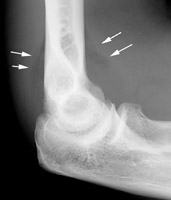
Radial head fractures can often be difficult to visualize on plain films especialing Mason Type 1 fractures (see prior pearl on classification system) which are nondisplaced. Often the only sign of a fracture will be a posterior fat pad sign which is always considered to be pathologic.  The posterior fat pad lies outside the synovium of the elbow joint and is normally hidden in the fossa of the distal humerus preventing it from being seen on lateral films of a normal elbow.  Trauma to the elbow that results in a intraarticular fracture (typically a radial head fracture) produces an intra-articular hemorrhage that distends the synovium and displaces the fat out of the fossa, producing the typical triangular radiolucent shadow posterior to the distal end of the humerus.
Show References


Title: Treatment of Back Pain

Category: Orthopedics

Keywords: Benzodiazepines, Back Pain, Sciatica (PubMed Search)

Posted: 5/8/2010 by Michael Bond, MD (Updated: 5/9/2010)

Conservative Treatment of Back Pain:

Muscle relaxanats and benzodiazipnes are often used in the non-operative management of sciatica and non-specific low back pain.  In fact, a 2003 Cochrane review concluded that muslce relaxanats were effective in the management of non-specific low back pain. However, a recent analysis of randomized trials reported little efficacy or only  minor benefits with the use of benzodiazapines in treatment of low back pain.

A recent prospective, randomized, placebo-controlled, double-blinded trial conducted in Germany that enrolled a total of 60 patients found that the use of diazepam was equivilant to placebo in the reduction of distance of referred pain at day 7 of treatment.  Diazepam was also noted on average to increase the length of stay of those patients hospitalized by 2 days (median hospital days of 8 for placebo versus 10 for diazepam), and the probablility of pain reduction on a visual analog scale by more than 50% was twice as high in the placebo group (p< 0.0015).  Placebo reduced the patients pain more than diazepam.

Though the sample size was small; this study should really make one reevaluate the use of diazepam in the treatment of back pain.  Early movement and discouraging bed rest have been associated with decreased back pain, so one mechanism by which  benzodiazepines may make things work is by causing enough sedation to prevent early movement.

Show References


Title: Carpal Tunnel Syndrome

Category: Orthopedics

Posted: 4/25/2010 by Michael Bond, MD (Updated: 3/4/2026)

Carpal Tunnel Syndrome (CTS):


Title: Conjunctivitis

Category: Ophthamology

Keywords: Conjunctivitis (PubMed Search)

Posted: 4/17/2010 by Michael Bond, MD (Updated: 8/28/2014)

All to often we see children that are sent to the ED for "Pink Eye" as the school nurse will not allow them back into class unless they are treated with antibiotics.  A recent study out of New York identified 4 factors that are associated with low risk (<8% chance) of bacterial (culture postive) conjunctivitis.  They are:

  1. age 6 years
  2. presentation during April through November
  3. watery or no discharge
  4. no glued eye in the morning

An editorial in journal watch comments that if this study can be replicated in other geographic areas we could change the practice of prescribing antibiotics that are not necessary.

Show References


Title: Prosthetic Hip Dislocatoins

Category: Orthopedics

Keywords: Hip Dislocation, Treatment (PubMed Search)

Posted: 4/11/2010 by Michael Bond, MD (Updated: 3/4/2026)

Prosthetic hip dislocations are a common occurance in the Emergency Department.  After you have gotten the hip back in place there are several ways to prevent the hip from coming out again.  An abductor pillow will work but it confines the patient to bed.  A better option to prevent further hip dislocations until the patient can get an appropriate brace made or reparative surgery is to place the patient in a straight leg knee immoblizer. It is nearly impossible to dislocate your hip if your knee is fully extended.

So after reduction of their simple hip dislocation (i.e: no fractures) place the patient in a straight leg knee immobolizer and they can followup with their orthopedist as an outpatient.


Title: Ossification Centers of the Elbow in Children

Category: Orthopedics

Keywords: Ossification Centers, Elbow (PubMed Search)

Posted: 3/27/2010 by Michael Bond, MD (Updated: 3/4/2026)

Review of the Appearance of Ossification Centers in Children's Elbows

Determing if a child's elbow has a fracture or if you are looking at an ossification center is easier if you remember the mnemonic CRITOE.  This is the order that the ossification centers appear:


Title: Critical Care Billing

Category: Misc

Keywords: Billing, Critical Care (PubMed Search)

Posted: 3/20/2010 by Michael Bond, MD

Critical Care billing is time dependent and includes all time spent caring for and coordinating (i.e.: reviewing records, talking to consultants or family) the care of the patient except for the time spent doing separately billable procedures (i.e. central line, CPR, etc).  The following procedures taken from the ACEP website are included in the Critical Care code so the time spent doing these procedures should BE included in your total Critical Care time . 

They are :

ACADEMIC MEDICINE CAVEAT: For the reporting of time-based services, such as critical care or moderate sedation, the teaching physician must be directly present during the entire reported time period.

Show References


Title: Knee Dislocation

Category: Orthopedics

Keywords: Knee, Dislocation (PubMed Search)

Posted: 3/13/2010 by Michael Bond, MD (Updated: 3/4/2026)

Knee Dislocation:

Show References


Title: Pelligrini-Stieda Lesion

Category: Orthopedics

Keywords: Pelligrini, Steida (PubMed Search)

Posted: 3/6/2010 by Michael Bond, MD

Pelligrini-Stieda Lesion:

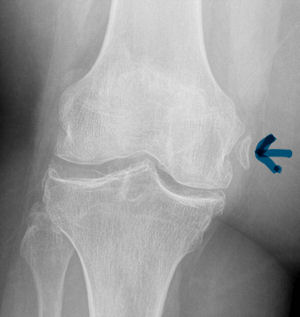
A Pelligrini-Stieda lesion is shown in the radiograph below.  This lesion was originally described in 1905, and is associated with a tear of the Medial Collateral Ligament.  Heterotrophic calcification forms causing chronic pain, which typically needs to be surgically excised.


So for the students out there, it is possible to diagnosis an MCL tear on plain radiographs.  Just not very often.


Title: Segond Fracture

Category: Orthopedics

Keywords: Segond Fracture (PubMed Search)

Posted: 2/27/2010 by Michael Bond, MD (Updated: 3/4/2026)

The Segond Fracture:

An benign appearing avulsion fracture of the lateral tibeal plateau that is marker for more significant injuries such as:

  1. Anterior Cruciate Ligament (ACL) tear associated with this fracture 75-100% of the time
  2. Injury to the Medial Meniscus occurs with a Segond fracture 66-75% of the time.

If this avulsion fracture is seen consider immobilzing the patients knee until they can follow up with Orthopedics and/or get an MRI to determine if additional injuries are present.


Title: Spine CT Scans

Category: Orthopedics

Keywords: Spine, Fracture, Diagnosis (PubMed Search)

Posted: 2/20/2010 by Michael Bond, MD

A recent study by Smith et al showed that the general abdomen/pelvic CT scan in trauma patients obtained with 5mm slices is a better screening test for spine fractures than plain films. They also showed that when compared to dedicated reconstructed thoracolumbar CT scan (2mm slices focused on the spine) it did not miss any clinically significant fractures.

The statistic for plain radiographs and the nonreconstructive CT scan are shown below.

 
Plain Radiographs
Nonreconstructive CT Scan
 
Lumbar
Thoracic
Lumbar
Thoracic
Sensitivity % [95% CI]
47 [33 to 62]
13 [3 to 32]
94 [83 to 99]
73 [50 to 89]
Specificity % [95%  CI]
91 [78 to 97]
71 [54 to 85]
95 [85 to 99]
94 [79 to 99]
Positive Predictive Value % [95% CI]
85 [66 to 96]
15 [2 to 45]
95 [86 to 99]
89 [67 to 99]
Negative Predictive Value % [95% CI]
61 [48 to 72]
56 [41 to 71]
93 [82 to 99]
83 [66 to 93]

The take home point is that dedicated Spine CT scans are probably not needed unless they are going to be used to guide surgical or non-surgical management, and plain films should probably be abandoned in patients that are undergoing CT scans of the chest/abdomen/pelvis.

Show References


Title: Impingement Syndrome and the Diagnostic Accuracy of 5 Common Tests

Category: Orthopedics

Posted: 2/14/2010 by Michael Bond, MD

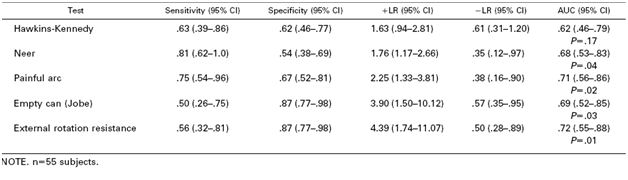
Impingement Syndrome and the Diagnostic Accuracy of 5 Common Tests

It is also reported that subacromial impingement syndrome (SAIS) is the more frequent cause of shoulder pain.

The authors of this study attempted to determine the diagnostic accuracy of the following 5 tests for SAIS:

The study demonstrated that any 3 positive tests out of the 5 has a sensitivity of 0.75 (0.54-0.96) , specificity of 0.74 (0.61-0.88), positive likelihood ratio of 2.93 (1.60-5.36) and negative likelihood ratio of 0.34 (0.14-0.80).  See the table below for the individual test characteristics.  No single test was deemed accurate enough to make the diagnosis by itself.


So in the end you should be familiar with most of these tests in order to use a combination of them to make the diagnosis of impingement syndrome.  Future pearls will review how to perform these tests.

Show References


Title: Scaphoid Fractures

Category: Orthopedics

Keywords: Scaphoid, Fracture (PubMed Search)

Posted: 2/6/2010 by Michael Bond, MD

Scaphoid Fractures:

For suspected scaphoid fractures with negative radiographs it is common practice to put a person in a short arm thumb spica splint until followup up radiographs can be obtained in 10-14 days.

However, there is evidence that a short arm thumb spica splint is not enough for people that have a true scaphoid fracture.  Gellman et al demonstrated that long arm thumb-spica cast immobilization for six weeks followed by short arm thumb-spica cast immobilization decreased time to union by 25% when compared to short arm thumb-spica casting alone.

The theory is that the short arm splint still allows for forearm rotation that can cause shearing motion of the volar radiocarpal ligaments.  A long arm splint prevents this shearing action.  The disadvantage of a long arm splint though is potential elbow joint stiffness and muscle atrophy that can occur during the prolonged period of immobilization.

So for your next patient with a scaphoid fracture seen on radiographs place them in a long arm thumb spica splint.

Show References


Title: Temporal Arteritis

Category: Misc

Keywords: Temporal Arteritis (PubMed Search)

Posted: 1/30/2010 by Michael Bond, MD (Updated: 3/4/2026)

Temporal Arteritis (TA) is commonly associated with the sudden onset of a unilateral headache centered around the temporal region.  The most devastating consequence of TA is blindness though this is only reported in up to 50% of cases though can be bilateral in up to 33% of patients.

According to the American College of Rheumatology criteria for classification of temporal arteritis this diagnosis can be made in the ED without a biopsy.  You just need at least 3 of the following 5 items to be present (sensitivity 93.5%, specificity 91.2%) to make the diagnosis :

  1. Age of onset older than 50 years
  2. New-onset headache or localized head pain
  3. Temporal artery tenderness to palpation or reduced pulsation
  4. Erythrocyte sedimentation rate (ESR) greater than 50 mm/h
  5. Abnormal arterial biopsy (necrotizing vasculitis with granulomatous proliferation and infiltration)

Show References


Title: Uveitis (Cont'd)

Category: Airway Management

Keywords: Uveitis, Treatment (PubMed Search)

Posted: 1/23/2010 by Michael Bond, MD (Updated: 3/4/2026)

Uveitis and Iritis Treatment:


Title: Uveitis and Iritis

Category: Ophthamology

Keywords: Uveitis, Iritis (PubMed Search)

Posted: 1/16/2010 by Michael Bond, MD

Iritis is a common diagnosis in the ED, but did you know it was actually a subset of Uveitis.

Uveitis is an inflammation of one or all parts of the uveal tract which consists of the iris, the ciliary body, and the choroid.
 
The subsets of uveitis are:

  1. anterior
  2. confined to the iris and anterior chamber -- iritis
  3. confined to the iris, anterior chamber, and ciliary body -- iridocyclitis.
  4. Posterior uveitis -- choroiditis and chorioretinitis, is uncommon, with the exception of cytomegalovirus (CMV) retinitis in patients with AIDS.


Treatment of iritis and uveitis next week.

Show References


Title: Paronychia

Category: Orthopedics

Keywords: Paronychia (PubMed Search)

Posted: 1/9/2010 by Michael Bond, MD

Acute paronychia


Title: Pityriasis Rosea

Category: Dermatology

Keywords: Pityriasis rosea (PubMed Search)

Posted: 1/3/2010 by Michael Bond, MD

Pityriasis Rosea


Title: Nikolsky's sign

Category: Dermatology

Keywords: Nikolsky's sign, Dermatology (PubMed Search)

Posted: 12/26/2009 by Michael Bond, MD (Updated: 3/4/2026)

Nikolsky's sign is positive when slight rubbing of the skin results in exfoliation of the skin's outermost layer.  The more technical term is acantholysis which is the loss of the normal adhesion of the epithelial skin cells which allows for this sloughing.

Seen in:

Often helpful to differentiate pemphigus vulgaris from bullous pemphigoid. The sign is usually absent in bullous pemphigoid.  Just be careful with how much testing you are doing as this can be very painful to the patient.


Title: Hypothermia

Category: Misc

Keywords: Hypothermia (PubMed Search)

Posted: 12/19/2009 by Michael Bond, MD (Updated: 3/4/2026)

Hypothermia Pearls:

Finally, remember to monitor the patient closely when you first start rewarming as this can induce cardiac arrest.  This is thought to occur as colder peripherial blood returns to the central circulation as peripherial veins and arteries dilated from the warm fluid.


Previous  |  1 |  2 |  3 |  4 |  5 |  6 |  7 |  8 |  9 |  10 |  11 |  12 |  ... |  14 |  Next