41-60 of 380 results with category "Neurology"

Previous  |  1 |  2 |  3 |  4 |  5 |  6 |  7 |  8 |  ... |  19 |  Next

Title: Are We Underdosing Benzodiazepines in Status Epilepticus?

Category: Neurology

Keywords: seizure, status epilepticus, benzodiazepine, antiepileptic, failure (PubMed Search)

Posted: 6/12/2019 by WanTsu Wendy Chang, MD

Bottom Line: Underdosing of benzodiazepines in status epilepticus may contribute to treatment failure.

Show References


Title: Cervical Spine Disease

Category: Neurology

Keywords: MRI, neuro exam, bladder, gait (PubMed Search)

Posted: 4/24/2019 by Danya Khoujah, MBBS (Updated: 3/4/2026)

Cervical spondylotic disease is the most common cause of myelopathy in patients over the age of 55 years and accounts for 25% of all hospitalizations for spastic quadriparesis.
It can be confused with lumbar spine disease as the most common presentation is a slowly progressive spastic gait dysfunction with 15-20% presenting with bladder disturbance.

Take Home Message: Don’t rush to localizing a lesion to the lumbar spine without performing a thorough neuro exam. 

Show References


Title: Intraosseous Administration of Hypertonic Saline

Category: Neurology

Keywords: 23.4%, mannitol, intracranial hypertension, herniation, IO (PubMed Search)

Posted: 4/11/2019 by WanTsu Wendy Chang, MD (Updated: 3/4/2026)

Bottom Line: Use of IO allows more rapid administration of 23.4% NaCl with no immediate serious complications.

Show References


Title: How Common are Headache and Back Pain Misdiagnoses?

Category: Neurology

Keywords: headache, back pain, misdiagnosis, stroke, intraspinal, epidural, abscess (PubMed Search)

Posted: 3/14/2019 by WanTsu Wendy Chang, MD (Updated: 3/4/2026)

Bottom Line: The rate of serious neurologic conditions missed at an initial ED visit is low.  However, the potential harm of misdiagnosis can be substantial.

Show References


Title: Cauda Equina - How Good is the H&P?

Category: Neurology

Keywords: spinal cord, physical exam, assessment (PubMed Search)

Posted: 2/28/2019 by Danya Khoujah, MBBS (Updated: 3/4/2026)

Back pain with lower extremity symptoms can be concerning for cauda equina. Some pointers regarding the H&P:

None of these symptoms independently predicts cauda equina syndrome with an accuracy greater than 65%.

Bottom Line: do not depend on any one finding to reliably exclude or confirm cauda equina.

Show References


Title: So Who is Supposed to Get tPA for Stroke Nowadays?

Category: Neurology

Keywords: stroke, thrombolytics, tPA (PubMed Search)

Posted: 1/23/2019 by Danya Khoujah, MBBS

Intravenous (IV) thrombolytics for stroke remain a controversial topic for emergency medicine (EM) physicians, with numerous editorials and articles questioning the strength of the recommendations by the AHA in 2018. Nevertheless, it is prudent for the emergency medicine provider to be aware that administration of IV tPA is a Level I recommendation in any stroke patient with a time of onset (or last known normal) up to 4.5 hours in patients with no contraindications. Clinical judgement should always direct care, and documentation for deviation from the guidelines (if any) should be done.

Show Additional Information

Show References


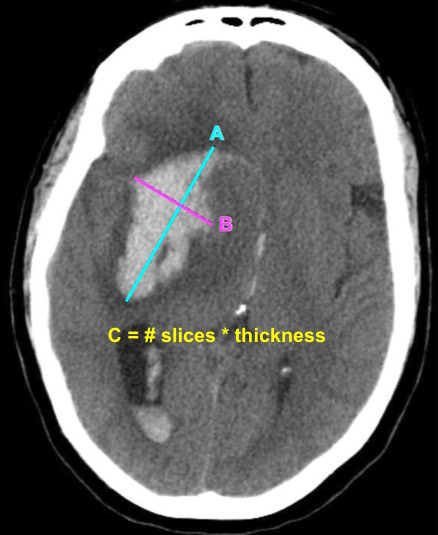
Title: How Good are Emergency Physicians in Estimating ICH Volume?

Category: Neurology

Keywords: Intracerebral hemorrhage, ICH, volume, ABC/2 (PubMed Search)

Posted: 1/9/2019 by WanTsu Wendy Chang, MD

Bottom Line:  EPs can reliably estimate ICH volume using the ABC/2 formula.  Communicating ICH volume to neurosurgical and neurocritical care consultants can help direct treatment decisions.

Show References


Title: Medication Overuse Headaches

Category: Neurology

Keywords: headache, post concussion syndrome (PubMed Search)

Posted: 12/23/2018 by Brian Corwell, MD (Updated: 12/23/2018)


A previous pearl discussed medication-overuse headache (MOH).

MOH is also known as analgesic rebound headache, drug-induced headache or medication-misuse headache.

It is defined as headache… occurring on 15** or more days per month in a patient with a preexisting headache disorder who has been overusing one or more acute treatment drugs for headache with symptoms for three or more months.

The diagnosis is clinical, and requires a hx of chronic daily headache with analgesic use more than 2-3d per week.

The diagnosis of MOH is supported if headache frequency increases in response to increasing medication use, and/or improves when the overused medication is withdrawn.

The headache may improve transiently with analgesics and returns as the medication wears off. The clinical improvement after wash out is not rapid however, patients may undergo a period where their headaches will get worse. This period could last in the order of a few months in some cases.

The meds can be dc’d cold turkey or tapered depending on clinical scenario.

Greatest in middle aged persons. The prevalence rages from 1% to 2% with a 3:1 female to male ratio.

Migraine is the most common associated primary headache disorder.

** Each medication class has a specific threshold.

Triptans, ergot alkaloids, combination analgesics, or opioids on ten or more days per month constitute medication overuse.

Use of simple analgesics, including aspirin, acetaminophen and NSAIDS on 15 or more days per month constitutes medication overuse. 

Caffeine intake of more than 200mg per day increases the risk of MOH.


Consider MOH in patients in the appropriate clinical scenario as sometimes doing less is more!


Title: Ultrasound-Assisted Lumbar Punctures

Category: Neurology

Keywords: ultrasound, lumbar puncture, LP, landmark (PubMed Search)

Posted: 12/12/2018 by WanTsu Wendy Chang, MD (Updated: 3/4/2026)

Bottom Line: Consider using pre-procedural ultrasound-assistance for all lumbar punctures.

Show References


Title: Seeing Double?

Category: Neurology

Keywords: diplopia, imaging, radiology, CT, ophthalmology (PubMed Search)

Posted: 11/28/2018 by Danya Khoujah, MBBS (Updated: 3/4/2026)

Diplopia can be a challenging complaint to address in the ED. Although not all patients will require imaging, use the simplified table below to help guide the imaging study needed:


Clinical Situation

Suspected Diagnosis

Imaging Study

Diplopia + cerebellar signs and symptoms

Brainstem pathology

MRI brain

6th CN palsy + papilledema

Increased intracranial pressure (e.g. idiopathic intracranial hypertension or cerebral venous thrombosis)

CT/CTV brain

3rd CN palsy (especially involving the pupil)

Compressive lesion (aneurysm of posterior communicating or internal carotid artery)

CT/CTA brain

Diplopia + thyroid disease + decreased visual acuity

Optic nerve compression

CT orbits

Intranuclear ophthalmoplegia

Multiple sclerosis

MRI brain

Diplopia + facial or head trauma

Fracture causing CN disruption

CT head (dry)

Diplopia + multiple CN involvement (3,4,6) + numbness over V1 and V2 of trigeminal nerve (CN5) +/- proptosis

Unilateral, decreased visual acuity

Orbital apex pathology

CT orbits with contrast

Uni- or bi-lateral, normal visual acuity

Cavernous sinus thrombosis

CT/CTV brain

C.N.: cranial nerve


Show References


Title: C-Spine Clearance by ED Triage Nurses?

Category: Neurology

Keywords: cervical, spine, clearance, triage, nurse, trauma (PubMed Search)

Posted: 11/14/2018 by WanTsu Wendy Chang, MD

Bottom Line: ED triage nurses can safely use the Canadian C-Spine Rule.  This approach can improve patient care and decrease length of stay in the ED.

Show References


Title: Neurosyphilis

Category: Neurology

Keywords: CSF, lumbar puncture, infectious diseases (PubMed Search)

Posted: 10/24/2018 by Danya Khoujah, MBBS

Manifestations due to neurosyphilis present as one of 3 categories: stroke due to arteritis, masses in the brain (granulomata), and chronic meningitis.

Although serum VDRL/TPPA tests will be positive in almost all patients, it’s important to remember that the diagnosis requires the presence of ALL of the following criteria:

1. positive treponemal (e.g. FTA-ABS, TP-PA) AND nontreponemal (e.g. VDRL, RPR) serum test results

2. positive CSF VDRL OR positive CSF FTA-ABS test result 

3. one CSF laboratory test abnormality, such as pleocytosis (cell count >20/μL) or high protein level (>0.5 g/L)

4. clinical symptoms

This is important because the treatment of neurosyphilis is distinctly different from other forms, as it requires admission for IV antibiotics for at least 10 days.  

Bonus Pearl: CSF RPR is unreliable as it is more likely to be falsely positive than other specific CSF testing.


Show References


Title: Early Dual Antiplatelet Therapy for Stroke Prevention?

Category: Neurology

Keywords: stroke, TIA, antiplatelet, aspirin, clopidogrel, POINT, CHANCE (PubMed Search)

Posted: 10/10/2018 by WanTsu Wendy Chang, MD

Does using a combination of aspirin and clopidogrel decrease your patient’s risk of recurrent stroke after a minor ischemic stroke or high risk TIA event?

Bottom Line: The use of DAPT in minor ischemic stroke and high risk TIA reduces the risk of recurrent stroke.  However, the duration of DAPT may affect the risk of major hemorrhage.

Show Additional Information

Show References


Title: Must transverse myelitis be symmetrical?

Category: Neurology

Keywords: weakness, sensory symptoms, MRI, LP (PubMed Search)

Posted: 9/26/2018 by Danya Khoujah, MBBS

Although transverse myelitis classically presents with bilateral and symmetric symptoms, it may be “partial” - symptoms would be asymmetric, or specific only to particular anatomic tracts.
In patients with risk factors (e.g. recent infection, history of autoimmune disease or cancer) and subacute ascending weakness/sensory symptoms, perform a thorough neurological exam, and obtain a gadolinium-enhanced MRI of the entire spine and/or lumbar puncture if you suspect transverse myelitis. 

Show References


Title: Weakness.. and a rash?

Category: Neurology

Keywords: shingles, weakness, infection (PubMed Search)

Posted: 8/22/2018 by Danya Khoujah, MBBS (Updated: 3/4/2026)

In patients presenting with acute weakness of the limb or trunk, be sure to ask about history of shingles or rash. They may have segmental zoster paresis.

Patients may develop weakness in a myotomal distribution similar to the dermatomal sensory symptoms and rash. However, weakness may develop up to 4 weeks after the rash, making the connection between the two presentations less apparent. 

Show References


Title: Anticoagulation in Cerebral Venous Thrombosis

Category: Neurology

Keywords: cerebral venous thrombosis, CVT, anticoagulation, low molecular weight heparin, LMWH, UFH (PubMed Search)

Posted: 8/8/2018 by WanTsu Wendy Chang, MD

Bottom Line: LMWH appear to be similar in efficacy and safety compared with UFH for the management of CVT.

Show References


Title: An ischemic stroke.. of the spinal cord?

Category: Neurology

Keywords: infarct, paralysis, numbness (PubMed Search)

Posted: 7/25/2018 by Danya Khoujah, MBBS

An infarct of the spinal cord is technically considered a stroke

The most common risk factor is a recent aortic surgery. Can also occur with straining and lifting (rare)

Patients will present with symptoms of spinal cord involvement with a hyperacute onset (less than 4 hours)

Although the “classic” presentation is anterior cord syndrome (flaccid paralysis, dissociated sensory loss (pinprick and temperature), preserved dorsal column function), patients may present with loss of all functions below the level of infarct due to spinal shock, confusing the clinical picture.

The most common level is T10

Show References


Title: Can my patient with dementia refuse treatment?

Category: Neurology

Keywords: capacity, dementia, altered mental status, medicolegal, ethics (PubMed Search)

Posted: 6/27/2018 by Danya Khoujah, MBBS

Medical decision-making capacity refers to the patient’s ability to make informed decisions regarding their care, and emergency physicians are frequently required to assess whether a patient possess this capacity. Patients with acute or chronic neurological diseases (such as dementia) may lack this capacity, and this should be identified, especially in life-threatening situations. The patient must have the ability to:

There are numerous tools that may help with this assessment, but none has been validated in the ED. Be careful of determining that the patient lacks capacity just because of the diagnosis they carry. 


BONUS PEARLS:


Show References


Title: Neuroimaging in Syncope - Is It Necessary?

Category: Neurology

Keywords: Syncope, neurological, neuroimaging, CT, MRI (PubMed Search)

Posted: 6/13/2018 by WanTsu Wendy Chang, MD (Updated: 3/4/2026)

Bottom Line: Consider obtaining neuroimaging in patients presenting with syncope only if clinical features suggest probable neurological syncope.

Show References


Title: Lhermitte's Sign

Category: Neurology

Keywords: myelopathy, myelitis, physical exam (PubMed Search)

Posted: 5/23/2018 by Danya Khoujah, MBBS (Updated: 3/4/2026)

Lhermitte’s phenomenon is as a sign of cervical spinal cord demyelination. It is considered positive if flexion of the neck causes a tingling sensation moving down the limbs or trunk, and may be reported as a symptom or elicited as a sign. This is due to stretching of the dorsal column sensory fibers, the commonest cause of which is multiple sclerosis. Other causes include other myelopathies, such as B12 deficiency, radiation and toxic (due to chemotherapy) or idiopathic myelitis. Its sensitivity is low at 16%, but its specificity for myelopathy is high at 97%.

Show References


Previous  |  1 |  2 |  3 |  4 |  5 |  6 |  7 |  8 |  ... |  19 |  Next