541-560 of 860 results with category "Critical Care"

Previous  |  1 |  ... |  23 |  24 |  25 |  26 |  27 |  28 |  29 |  30 |  31 |  32 |  33 |  ... |  43 |  Next

Title: Procalcitonin Algorithms to Guide Antibiotic Therapy in Upper Respiratory Infections (URIs).

Category: Critical Care

Keywords: Procalcitonin, Upper respiratory infections, antibiotics (PubMed Search)

Posted: 9/24/2013 by Feras Khan, MD (Updated: 3/4/2026)

Background:

Clinical Question:

Meta-analysis:

Conclusions:

Limitations:

Bottom Line:

Show References


Title: Peri-Intubation Cardiac Arrest

Category: Critical Care

Posted: 9/17/2013 by Mike Winters, MBA, MD (Updated: 3/4/2026)

Peri-Intubation Cardiac Arrest

Show References


Title: Necrotizing Pneumonia

Category: Critical Care

Keywords: critical care, necrotizing pneumonia, infectious disease, pulmonary (PubMed Search)

Posted: 9/10/2013 by John Greenwood, MD (Updated: 9/10/2013)


Necrotizing Pneumonia
 

Necrotizing pneumonia is a rare, but potentially deadly complication of bacterial pneumonia.

It is characterized by the finding of pneumonic consolidation with multiple areas of necrosis within the lung parenchyma. Necrotic foci may coalesce, resulting in a localized lung abscess, or pulmonary gangrene if involving an entire lobe.

Most common pathogens: S. aureus, S. pneumoniae, and Klebsiella pneumonia.  
Others include S. epidermidis, E. coli, Acinetobacter baumannii, H. influenzae and Pseudomonas.

Contrast-enhanced chest CT is the diagnostic test of choice and is also helpful in evaluating  for parenchymal complications. 

Empiric antibiotic therapy should include:

Consider an early surgical evaluation for the patient with necrotizing pneumonia complicated by septic shock, empyema, bronchopleural fistula, or hemoptysis. 

Show References


Title: Upper Extremity Deep Vein Thrombosis (UEDVT)

Category: Critical Care

Posted: 9/3/2013 by Haney Mallemat, MD

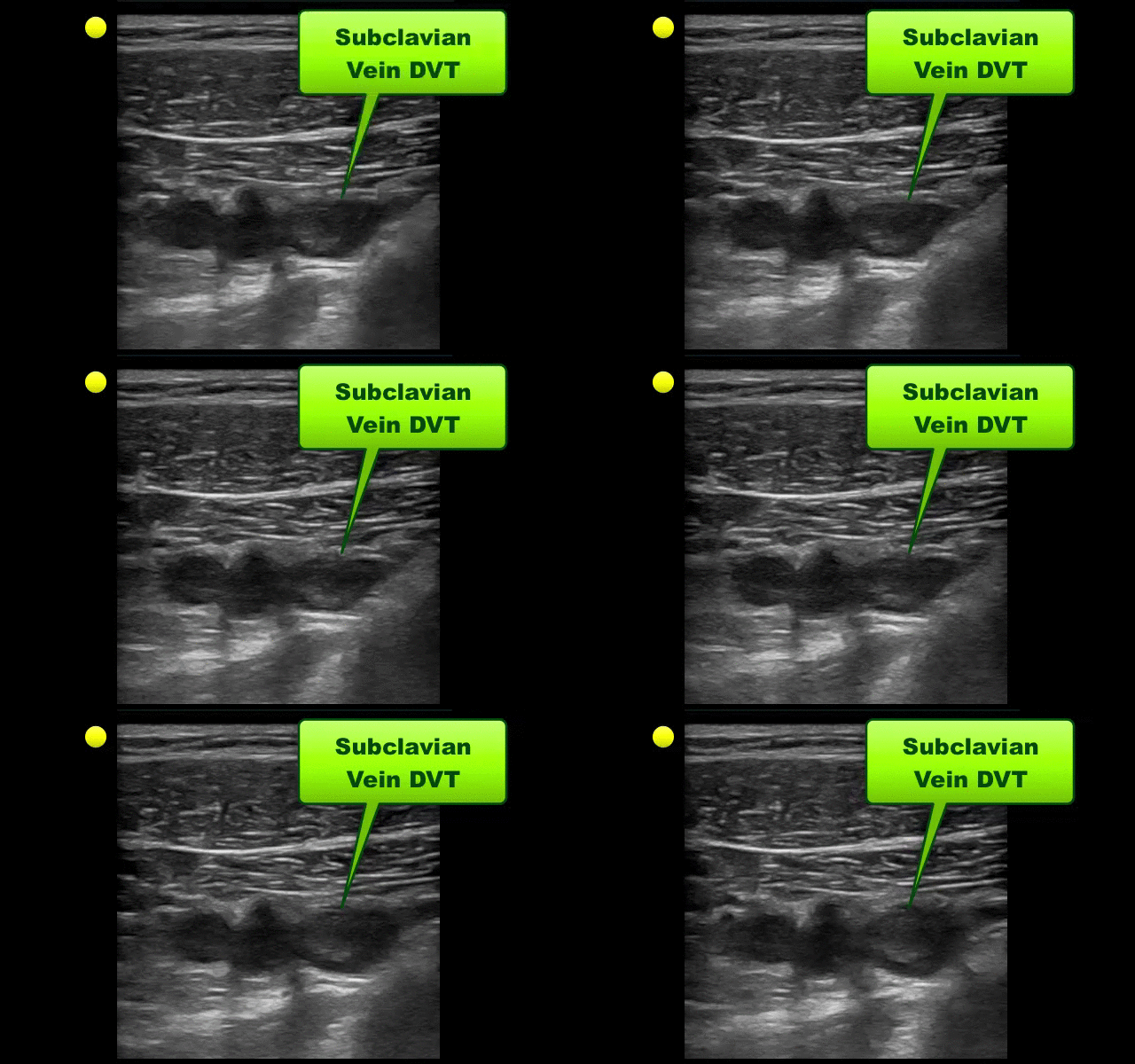
UEDVT comprise 10% of all DVTs (majority are lower extremity), but incidence of UEDVT is rising; UEDVTs are categorized into distal (veins distal to axillary vein) or proximal (from superior vena cava to axillary vein)

Compared to lower extremity DVT, UEDVTs have lower:

75% of UEDVT are secondary (indwelling catheters, pacemakers, malignancy, etc.) and 25% are primary in nature; #1 primary cause of UEDVT is Paget – Schroetter disease

Up to 25% of patients with primary UEDVTs are eventually found to have an underlying malignancy; patients with idiopathic UEDVT should be referred for cancer workup

Treatment includes removal of the catheter (if no longer needed) and:


Show References


Title: Dual Antiplatelet Therapy in Acute TIA and Minor Stroke: CHANCE Trial

Category: Critical Care

Keywords: TIA, Minor Stroke, Antiplatelet therapy (PubMed Search)

Posted: 8/27/2013 by Feras Khan, MD (Updated: 3/4/2026)


Background

Trial

Results

Conclusions

Bottom Line:

Show References


Title: CDAD in the Elderly Patient

Category: Critical Care

Posted: 8/14/2013 by Mike Winters, MBA, MD

Clostridium Difficile Associated Diarrhea and The Elderly Patient

Show References


Title: Bad brain, good lungs.... Right?

Category: Critical Care

Keywords: Neurocritical care, Ventilator Strategies, ARDS, Intracranial hemorrhage (PubMed Search)

Posted: 8/6/2013 by John Greenwood, MD (Updated: 8/6/2013)


Bad brain, good lungs.... Right?

A recent retrospective study reviewed the incidence of acute respiratory distress syndrome (ARDS) in patients presenting with spontaneous intracerebral hemorrhage over a 10-year period.  After reviewing 1,665 patients, the authors found that:

It's of particular importance to note that high tidal volume ventilation (>8cc/kg) was the single greatest modifiable factor for the development of ARDS.

Bottom line:  Try and use lung-protective ventilation strategies (6-8cc/kg ideal body weight) and avoid excessive volume resuscitation in your critically-ill patients whenever possible.  Even in cases of isolated intracerebral hemorrhage - where the patient's lungs may appear to be completely normal - traditional tidal volume settings may be harmful.

Show References


Title: What's the Diagnosis? Critical Care Edition

Category: Critical Care

Posted: 7/30/2013 by Haney Mallemat, MD

Question

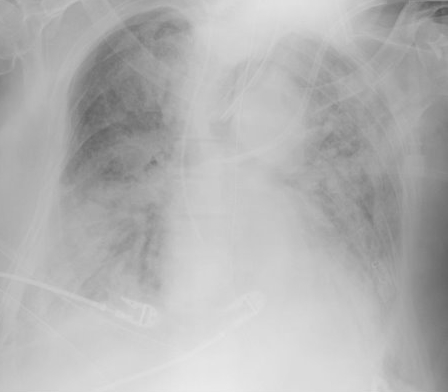
Elderly patient who originally presented for severe pancreatitis now intubated for worsening hypoxemia. CXR is shown below, what's the diagnosis?  

Show Answer

Show References


Title: HIV, ART, and the ICU

Category: Critical Care

Posted: 7/23/2013 by Mike Winters, MBA, MD (Updated: 3/4/2026)

HIV, ART, and the ICU

Show References


Title: R.E.D.U.C.E. trial: Is Less...Best?

Category: Critical Care

Posted: 7/16/2013 by Haney Mallemat, MD

COPD treatment guidelines (e.g., GOLD) recommend 10-14 days of steroid therapy following a COPD exacerbation to prevent recurrences; the supporting data is weak.

A recent noninferiority trial (here) compared patients with a severe COPD exacerbation who received either a 5-day course (n=156) or 14-day course (n=155) of prednisone 40mg.

The results were:

What you need to know:

Bottom-line: 5 days of prednisone may be as effective as 14-days for COPD exacerbations.

Show References


Title: More Buck without a lot of Bang: More Bad News for HES

Category: Critical Care

Posted: 7/2/2013 by Haney Mallemat, MD

Hydroxyethyl starch (HES) is a colloid used for volume resuscitation in critically-ill patients.

Previous studies (click here) have compared crystalloids to HES during fluid resuscitation and have demonstrated that HES has an increased cost with more adverse effects. Adverse effects may include:

In the United States, the Federal Drug Administration published a warning on June 24th 2013 with respect to the use of HES in critically ill adult patients. Specifically, it warned about the use of HES in patients,

If a decision to use HES is made, the FDA warning advises to:

Bottom line: With an increased cost and evidence of harm compared to crystalloids, it appears the indications for use of HES are rapidly declining.

Show References


Title: CVP and Fluid Responsiveness

Category: Critical Care

Posted: 6/25/2013 by Mike Winters, MBA, MD (Updated: 3/4/2026)

CVP and Fluid Responsiveness

Show References


Title: Immune Thrombocytopenia Purpura (ITP)

Category: Critical Care

Posted: 6/18/2013 by Haney Mallemat, MD

Keep Immune Thrombocytopenic Purpura (ITP) in your differential for patients with thrombocytopenia and evidence of bleeding. Although ITP has classically been described in children, it can occur in adults; especially between 3rd- 4th decade.

Thrombocytopenia leads to the extravasation of blood from capillaries, leading to skin bruising, mucus membrane petechial bleeding, and intracranial hemorrhage.

ITP occurs from production of auto-antibodies which bind to circulating platelets. This leads to irreversible uptake by macrophages in the spleen. Causes of antibody production include:

Suspect ITP in patients with isolated thrombocytopenia on a CBC without other blood-line abnormalities. Abnormality in other blood-line warrants consideration of another diagnosis (e.g., leukemia).

ITP cannot be cured; treatments include:


Title: Rhabdomyolysis in the Critically Ill

Category: Critical Care

Posted: 6/11/2013 by Mike Winters, MBA, MD

Rhabdomyolysis in the Critically Ill

Show References


Title: Be Bold and Make Inpatients Cold

Category: Critical Care

Posted: 6/4/2013 by Haney Mallemat, MD

Therapeutic hypothermia (TH) following out-of-hospital cardiac arrest (OHCA) has increasingly been utilized since it was first described. TH following in-hospital cardiac arrest (IHCA), on the other hand, is not as commonplace or consistent despite a recommendation by the American Heart Association (AHA).

A recent prospective multi-center cohort-study demonstrated that of 67,498 patients with return of spontaneous circulation (ROSC) following IHCA only 2.0% of patients had TH initiated; of those 44.3% did not even achieve the target temperature (32-34 Celsius). 

The factors found to be most associated with instituting TH were:

Bottom-line: Hospitals should consider instituting and adhering to local TH protocols for in-house cardiac arrests.

Show References


Title: End-Expiratory Occlusion Test

Category: Critical Care

Posted: 5/28/2013 by Mike Winters, MBA, MD (Updated: 3/4/2026)

End-expiratory Occlusion Test

Show References


Title: The Macklin Effect by Dr. Ali Farzad

Category: Critical Care

Posted: 5/21/2013 by Haney Mallemat, MD

The Macklin Effect

Pneumomediastinum (click here for image) may be caused by many things:

  1. Esophageal perforation (e.g., complication from EGD)
  2. Tracheal / Bronchial injury (e.g., trauma, complication of bronchoscopy, etc.)
  3. Abdominal viscus perforation with translocation of air across the diaphragmatic hiatus
  4. Air may reach mediastinum along the fascial planes of the neck.
  5. Alveolar rupture, also known as the "Macklin Effect"

The "Macklin Effect" is typically a self-limiting condition leading to spontaneous pneumomediastinum and massive subcutaneous emphysema after the following:

  1. Alveolar rupture from increased alveolar pressure (e.g., asthma, blunt trauma, positive pressure ventilation, etc.)
  2. Air released from alveoli dissects along broncho-vascular sheaths and enters mediastinum
  3. Air may subsequently track elsewhere (e.g., cervical subcutaneous tissues, face, epidural space, peritoneum, etc.)

Pneumomediastinum secondary to the Macklin effect frequently leads to an extensive workup to search for other causes of mediastinal air. Although, no consensus exists regarding the appropriate workup, the patient's history should guide the workup to avoid unnecessary imaging, needless dietary restriction, unjustified antibiotic administration, and prolonged hospitalization.

Treatment of spontaneous pneumomediastinum includes:

Show References


Title: Hyperosmolar Therapy in Neurocritical Care

Category: Critical Care

Posted: 5/14/2013 by Mike Winters, MBA, MD (Updated: 3/4/2026)

Monitoring Hyperosmolar Therapy

Show References


Title: Can your breath, predict fluid responsiveness best?

Category: Critical Care

Posted: 5/7/2013 by Haney Mallemat, MD

Fluid boluses are often administered to patients in shock as a first-line intervention to increase cardiac output. Previous literature states, however, that only 50% of patients in shock will respond to a fluid bolus. 

Several validated techniques exist to distinguish which patients will respond to a fluid bolus and which will not; one method is the passive leg raise (PLR) maneuver  (more on PLR here). A drawback to PLR is that it requires direct measurement of cardiac output, either by invasive hemodynamic monitoring or using advanced bedside ultrasound techniques.

Another technique to quantify changes in cardiac output is through measurement of end-tidal CO2 (ETCO2). The benefits of measuring ETCO2 is that it can be continuously measured and can be performed non-invasively on mechanically ventilated patients.

A 5% or greater increase in end-tidal CO2 (ETCO2) following a PLR maneuver has been found to be a good predictor of fluid responsiveness with reliability similar to invasive measures.


Show References


Title: NMBA Pearls

Category: Critical Care

Posted: 4/30/2013 by Mike Winters, MBA, MD

Neuromuscular Blocking Agents in the Critically Ill

Show References


Previous  |  1 |  ... |  23 |  24 |  25 |  26 |  27 |  28 |  29 |  30 |  31 |  32 |  33 |  ... |  43 |  Next