221-240 of 860 results with category "Critical Care"

Previous  |  1 |  ... |  7 |  8 |  9 |  10 |  11 |  12 |  13 |  14 |  15 |  16 |  17 |  ... |  43 |  Next

Title: Complication of vasopressor infusion through peripheral venous catheter: A systematic review and meta-analysis

Category: Critical Care

Keywords: vasopressor, peripheral IV, safety (PubMed Search)

Posted: 11/17/2020 by Quincy Tran, MD, PhD (Updated: 3/4/2026)

Summary

Our group performed a meta-analysis to assess whether it is safe to infuse vasopressor through peripheral venous catheters.  We identified 9 studies with a total of 1835 patients.  The prevalence of complications among the pooled patient population was 9%.  Up to 96% of the complications was extravasation and almost no complications required any treatment.

A few studies reported safe infusion of norepinephrine up to 0.1 mcg/kg/min for up to 24 hours.

In exploratory meta-regression, catheter size 20 or larger was negatively associated with the rate of complications.

We also observed that studies that were published within the past 5 years reported significantly lower rate of complications from older studies.  This suggested that with careful planning and monitoring, it is safe to start vasopressor through peripheral IV.

Limitation

most of the included studies were observational. No studies had enough power to statistically analyze any variables that could predict complications.

Bottom line: we should start vasopressor as soon as indicated, if we have good, reliable IV access.


Show References


Title: Risk of Overcorrection in Rapid Intermittent Bolus vs Slow Continuous Infusion Therapies of Hypertonic Saline for Patients With Symptomatic Hyponatremia: The SALSA Randomized Clinical Trial

Category: Critical Care

Keywords: Hyponatremia (PubMed Search)

Posted: 11/12/2020 by Caleb Chan, MD

Significance: 
There have been few high-quality studies regarding slow continuous infusion (SCI) of hypertonic vs. rapid intermittent bolus (RIB) therapy for patients with symptomatic hyponatremia
 
Study Design:
Multicenter, open-label RCT with 178 patients (both ED and inpatient) with corrected Na of 125 mml/L or lower with moderate/severe symptoms
-Moderate symptoms:  nausea, headache, drowsiness, general weakness, and malaise
-Severe symptoms: vomiting, stupor, seizure, and coma (Glasgow Coma Scale [GCS] score ≤8)
Relevant excluded patient populations: liver disease/cirrhotics, uncontrolled diabetics, primary polydypsia, anuric, hypotensive
 
Intervention:
Slow continuous infusion (SCI) of hypertonic vs. Rapid intermittent bolus (RIB) therapy 
(see treatment algorithms  for specifics)
 
Results:
Primary outcome: No difference in rates of overcorrection 
15 of 87 (17.2%) patients in the RIB group vs.  22 of 91 (24.2%) patients in the SCI group 
-(absolute risk difference, −6.9% [95% CI, −18.8% to 4.9%]; P = .26)
 
Other outcomes:
RIB group showed a lower incidence of relowering treatment than the SCI group 
-(absolute risk difference, −15.8% [95% CI, −30.3% to −1.3%]; P = .04; NNT, 6.3)
 
RIB group had higher proportion of patients achieving target correction rate within 1 hour than the SCI group 
-(absolute risk difference, 14.6% [95% CI, 2%-27.2%]; P = .02; NNT, 6.8)
 
No significant differences between the groups were observed in:
- symptoms at 24 and 48 hours after treatment initiation
- first time to an increase in sNa 5 mmol/L or greater after treatment initiation
- incidence of target correction rate
- time from treatment initiation to achievement of sNa greater than 130 mmol/L
- length of hospital stay 
 
There were no cases of osmotic demyelination syndrome in either group
 
Take-home point:
Rapid intermittent boluses of hypertonic saline may be just as effective as slow continuous infusions for certain patient populations with moderate/severe symptomatic hyponatremia (and may actually have decreased rates of need for re-lowering treatment)
 
Limitations:
-smaller study
-high number of dropout due to protocol violation
-remember that ODS is multifactorial (liver disease, chronic alcoholism, malnutrition)


Show References


Title: Supraglottic airways to prevent aerosol spread during chest compressions in the COVID-19 era.

Category: Critical Care

Keywords: airway management, cardiac arrest, COVID-10, SARS-CoV-2, cardiopulmonary resuscitation, CPR (PubMed Search)

Posted: 11/3/2020 by Kami Windsor, MD


As the number of COVID-19 cases rises worldwide, prehospital and emergency department healthcare workers remain at high risk of exposure and infection during CPR for patients with cardiac arrest and potential SARS-CoV-2. 

Existing evidence supports similar cardiac arrest outcomes in airways managed with a supraglottic airway (SGA) compared to endotracheal intubation (ETT).1  It is generally accepted that the best airway seal is provided with endotracheal intubation + viral filter, but how well do SGAs prevent spread of aerosols? 

In CPR simulation studies:

 
Bottom Line: 

Show References


Title: Use of N-Acetylcysteine for non-acetaminophen acute liver failure

Category: Critical Care

Keywords: NAC, Liver Failure, n-acetylcysteine (PubMed Search)

Posted: 10/20/2020 by Mark Sutherland, MD (Updated: 3/4/2026)

N-acetylcysteine (NAC) is well known as the accepted antidote for acute acetaminophen (tylenol/paracetamol) overdose and is well studied for this indication.  While the literature base is not nearly as strong in other causes of acute liver failure, NAC is increasingly used in these scenarios as well.  In the emergency department in particular, the cause of fulminant hepatic failure is often not known.  NAC may have some protective benefit in non-acetaminophen acute liver failure.  Existing data do not show a mortality benefit to NAC in non-acetaminophen acute liver failure, but do show improvement in transplant-free survival.  The AASLD guidelines (last revised in 2011) do not comment on NAC in non-acetaminophen acute liver failure.  A common practice is to continue NAC until the INR is < 2 and AST/ALT have decreased at least 25% from their peak values.  

Patients in fulminant liver failure should also be strongly considered for transfer to a center that does liver transplant, if presenting to a non-transplant center.  The King's College criteria is the most commonly used prognostic score for determining need of transfer to a transplant center, but in addition to calculating a King's College score providers should generally consider consultation with a transplant hepatologist for any fulminant liver failure patient to discuss the risks/benefits of transfer for transplant evaluation.


Bottom Line: While not as strongly indicated as it is in acute acetaminophen induced liver failure, NAC should be considered in both non-acetaminophen liver failure and liver failure of unknown etiology.  In addition, strongly consider consultation with a transplant hepatologist in any case of fulminant hepatic failure.

Show References


Title: Blood Pressure in Acute Ischemic Stroke

Category: Critical Care

Posted: 10/13/2020 by Mike Winters, MBA, MD (Updated: 3/4/2026)

Blood Pressure Management in Acute Ischemic Stroke

Show References


Title: Association of Intra-arrest Transport vs Continued On-Scene Resuscitation With Survival to Hospital Discharge Among Patients With Out-of-Hospital Cardiac Arrest

Category: Critical Care

Keywords: Cardiac arrest, transport, EMS (PubMed Search)

Posted: 9/29/2020 by Lindsay Ritter, MD

Historically, there has been debate on transporting outside hospital cardiac arrests, as well a trauma, with the question of whether to "scoop and run" or "stay and play". 

Could hasty transportation of cardiac arrest patients put a damper on resuscitation quality? 

A recent propensity-matched study in JAMA analyzed 192 EMS agencies across 10 N American sites.

Methods:

-Resuscitation Outcomes Consortium Cardiac Epidemiologic Registry, which counted 43,969 consecutive cases of nontraumatic adult EMS-treated OHCA (median age 67, 37% of whom were women) in 2011-2015.

-25% of these patients were transported to the hospital

-Matched 1:1 with patients in refractory arrest who were resuscitated on scene 

-Primary outcome was survival to hospital discharge, secondary outcome survival to hospital discharge with a favorable neurological status 


Results:

-Duration of out-of-hospital resuscitation was only 6 minutes longer in the intra-arrest transport group (29.1 and 22.9 minutes; not a statistically significant difference)

-Survival to hospital discharge was 3.8% for patients who underwent intra-arrest transport and 12.6% for those who received on-scene resuscitation

-In the propensity-matched cohort, which included 27,705 patients, survival to hospital discharge occurred in 4.0% of patients who underwent intra-arrest transport vs 8.5% who received on-scene resuscitation (risk difference, 4.6% [95% CI, 4.0- 5.1])

-Favorable neurological outcome occurred in 2.9% of patients who underwent intra-arrest transport vs 7.1% who received on-scene resuscitation (risk difference, 4.2% [95% CI, 3.5%-4.9%])

-Intra-arrest transport during resuscitation was associated with worse odds of survival to hospital discharge compared to on-scene resuscitation (4% vs 8.5%, RR 0.48, CI 0.43-0.54)

-Findings persisted across subgroups of initial shockable rhythm vs. non-shockable rhythms (most common initial rhythm was aystole), as well as EMS witness arrests vs. unwitnessed arrests 


Conclusion:

-This study does not support the routine transportation of patients in cardiac arrest during rescuscitation.

-The neurologically intact survival benefit associated with on-scene resuscitation is both impressive and intriguing.

-However, what implications could this have on ECPR? 


Limitations:

-Potential bias due to observational nature of study 

-Duration of resuscitations very similar, unknown exactly how long transport times were or if this was in urban or rural populations

-External validity not generalizable due to heterogeneity of patient populations and EMS systems

-Further randomized clinical trials are required

Show Additional Information

Show References


Title: The Magnitude of Blood Pressure Reduction Predicts Poor In-Hospital Outcome in Acute Intracerebral Hemorrhage

Category: Critical Care

Keywords: IPH, blood pressure management, outcome (PubMed Search)

Posted: 9/22/2020 by Quincy Tran, MD, PhD

A retrospective study analyzed data from 757 patients with spontaneous intraparenchymal hemorrhage.

Within the first 6 hours of admission, patients who had systolic blood pressure reduction between 40 – 60 mm Hg (OR 1.9, 95% CI 1.1-3.5) or reduction ≥ 60 mm Hg (OR 1.9, 95%CI 1.01-3.8) were associated with almost double likelihood of poor discharge functional outcome (defined as modified Rankin Scale 3-6).

Additionally, large systolic blood pressure reduction ≥ 60 mm Hg in patients with large hematoma (≥ 30.47 ml) was associated with higher likelihood of very poor functional outcome (mRS 5-6).

Take home points: while more studies are still needed to confirm these observations, perhaps we may not want to drop blood pressure in patients with spontaneous intraparenchymal hemorrhage too much and too fast.

Show References


Title: Early Norepinephrine for Septic Shock

Category: Critical Care

Posted: 9/18/2020 by Caleb Chan, MD

Systematic review and meta-analysis of 5 studies with a total of 929 patients comparing early vs. late initiation of norepinephrine in patients with septic shock

Primary outcome:

Secondary outcome:

Caveat:

Take home point:

Early norepinephrine usage may improve mortality in septic shock

Show References


Title: VExUS to Detect Venous Congestion

Category: Critical Care

Keywords: resuscitation, ultrasound, VExUS, venous congestion (PubMed Search)

Posted: 9/8/2020 by Kami Windsor, MD


While the invasive monitoring of central venous pressure (CVP) in the critically ill septic patient has gone the way of also transfusing them to a hemoglobin of 10 mg/dL, it remains that an elevated CVP is associated with higher mortality1,2 and renal failure.2,3

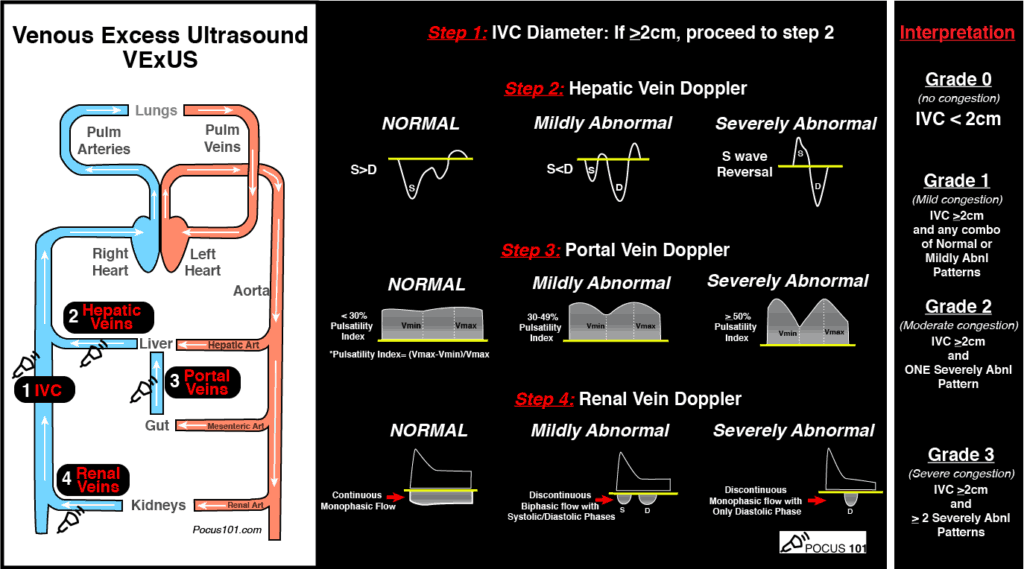
Extrapolating from existing data looking at hepatic vein, portal vein, and renal vein pulsatility as measures of systemic venous hypertension and congestion,4,5,6 Beaubien-Souligny et al. developed the venous excess ultrasound (VExUS) grading system incorporating assessment of all 3, plus the IVC, using US to stage severity of venous congestion in post-cardiac surgery patients.7 They evaluated several variations, determining that the VExUS-C grading system was most predictive of subsequent renal dysfunction.


(Image from www.pocus101.com)
 

High Points

       VExUS Grade 3 (severe) venous congestion:


Caveats


Clinical Uses


A great how-to can be found here:

https://www.pocus101.com/vexus-ultrasound-score-fluid-overload-and-venous-congestion-assessment/


Show References


Title: Early vs. Standard initiation of renal replacement therapy

Category: Critical Care

Keywords: Renal Replacement Therapy (PubMed Search)

Posted: 9/1/2020 by Kim Boswell, MD (Updated: 3/4/2026)

STARRT-AKITrial

The Standard versus Accelerated initiation of Renal Replacement Therapy in Acute Kidney Injury

The development of acute kidney injury (AKI) in the critical care setting portends a greater morbidity and mortality for patients. Additionally, it places the patient at high risk of complications and requires a greater use of resources. Several studies in the past have examined if the timing of initiation of renal replacement therapy (RRT) would result in a mortality benefit, but have failed to demonstrate consistent outcomes.

The STARRT-AKI trial was a multinational, randomized controlled trial designed to determine if early initiation of RRT in critically ill adult patients with AKI lowered the risk of 90-day mortality. The Kidney Disease Improving Global Outcomes (KDIGO) classification was used to define AKI and over 2900 patients were randomly assigned to two groups over a 4 year period. Exclusion criteria included: recent RRT, a renal transplant within the preceding year, advanced CKD, an overdose necessitating RRT, or a strong suspicion of obstruction or autoimmune/vascular cause of their AKI.

Groups:

Outcomes/Results:

Take home points:

Show References


Title: Ketamine in the Critically Ill

Category: Critical Care

Posted: 8/25/2020 by Mike Winters, MBA, MD (Updated: 3/4/2026)

Ketamine In the Critically Ill Patient

Show References


Title: METCOVID

Category: Critical Care

Keywords: COVID-19, ARDS, Pneumonia, Steroids (PubMed Search)

Posted: 8/17/2020 by Mark Sutherland, MD

Another week, another COVID-19 study...

On August 12th, the Metcovid study was e-published ahead of print in Clinical Infectious Diseases.  This was another study looking at steroids in COVID-19 pneumonia, this time performed in Brazil.  Metcovid was a parallel, double-blind, randomized, placebo-controlled phase IIb clinical trial which enrolled 416 patients at a single academic center for the evaluation of methylprednisolone (MP; 0.5 mg/kg BID x 5 days) vs placebo.  As with all COVID studies, Metcovid has some significant limitations, and some equivocal findings.  However, Metcovid was largely in line with RECOVERY and other trials looking at steroids in COVID-19, which lends it some face validity.  Metcovid found no significant difference in the primary outcome (mortality at day 28), but did find a difference in mortality in patients over 60 years old (a post-hoc analysis).  Metcovid was probably underpowered (sample size was based on a 50% reduction in mortality), and did have a very small trend towards reduced mortality in the MP group (37.1% vs 38.2%, p=0.629).

Bottom Line: 

Show References


Title: Chest US is more sensitive than Chest X ray for detection of traumatic pneumothorax

Category: Critical Care

Keywords: Ultrasound, Trauma, Pneumothorax (PubMed Search)

Posted: 8/11/2020 by David Gordon, MD

While chest X ray (CXR) is routinely obtained in the setting of traumatic injury, ultrasound (US) is a fast and reliable way to evaluate for life-threatening traumatic injuries requiring emergent intervention, and is supported by the Eastern Association for the Surgery of Trauma (EAST) guidelines. A recent Cochrane Review compared the test characteristics of chest US vs CXR for detection of traumatic pneumothorax when using Chest CT or thoracostomy as the gold standard.

There possible weaknesses of this study, including blinding in the original studies, and several studies may or may not have been at risk for bias as their risk of bias was ‘unclear’.  However, the results were consistent across the studies analyzed and remained similar after sensitivity analysis.

Several anatomical as well as patient care issues may confound US findings for pneumothorax such as the presence of bleb, prior thoracic surgery or pathology, as well as main stem intubation.

Bottom line:  While the presence of pneumothorax is on either CXR or US is highly likely to represent the a true pneumothorax, ultrasound is a far superior screen for the detection of pneumothorax in the trauma patient.


Show References


Title: HALT-IT Trial: TXA in GI bleeds

Category: Critical Care

Keywords: gastrointestinal bleeding, TXA (PubMed Search)

Posted: 8/4/2020 by Lindsay Ritter, MD (Updated: 8/4/2020)

Prior to this study, a Cochrane review and meta-analysis of TXA for upper GI bleeds with 7 trials (1654 patients), showed a large reduction in mortality with TXA (RR 0.61, 95% CI 0.42-0.98, p=0.01)

Design:

-Randomized, international, multicentre, placebo-controlled trial at 164 hospitals in 15 countries Juy 2013-2019

->16/18 years old with upper or lower GI bleeding

-1 g TXA IV over 10 minutes followed by maintenance dose 3 g TXA over 24 hours 


Results:

-Main outcome death due to bleeding within 5 days 

-4% (222/5994) died in TXA group vs 4% (226/5981) placebo risk ratio RR 0.99, 95% CI 0.82-1.18 

-Arterial thromboembolic events MI/CVA similar in both groups (0.7% vs 0.8%)

-Venous thromboembolic events PE/DVT higher in TXA group (0.8% vs 0.4%)


Pitfalls:

-Initially calculated all cause mortality until realization that over half deaths were due to non-bleeding causes, changed to death related to bleeding, allowing study appropriate power to detect difference 

-Majority of patients had UGIB/variceal bleeding due to liver disease, over 75% deaths in those with liver disease 

-Only 16% patients randomized in <3 hours, most >8 hours (CRASH-2 trial found benefit TXA in trauma patients only <3 hrs to administration) 


Takeaway:

-TXA should not be used in the management of GI bleeds

-Increased venous thromboembolic events associated with TXA administration for GI bleeds

Show Additional Information

Show References


Title: Lactated Ringer's Versus 4% Albumin on Lactated Ringer's in Early Sepsis Therapy in Cancer Patients: A Pilot Single-Center Randomized Trial

Category: Critical Care

Keywords: albumin, crystalloids, sepsis (PubMed Search)

Posted: 7/25/2020 by Quincy Tran, MD, PhD (Updated: 7/28/2020)

Patient 

  • Single Center, double-blinded, randomized trial. 

  • Patients with cancer and septic shock 

Intervention 

  • 4% albumin + lactate ringer bolus in 10 minutes 

  • 180 patients 

Comparison 

  • Lactate ringer bolus in 10 minutes 

  • 180 patients 

Outcome 

  • Primary: Any mortality within 7 days of randomization. 

  • Secondary: Mortality within 28 days, renal replacement therapy (RRT) 

Results: 

  • 7-day mortality: 46 (25%) for LR + albumin vs. 40 (22%) for LR only 

  • 28-day mortality: 96 (53%) for LR + albumin vs. 83 (46%) for LR only 

  • RRT: 16 (9%) for LR + albumin vs. 12 (7) for LR only 

Conclusion: 

Adding albumin for early resuscitation to crystalloids did not improve mortality in cancer patients with septic shock. 


Show References


Title: ROX Index for Predicting Outcomes of HFNC

Category: Critical Care

Posted: 7/21/2020 by Caleb Chan, MD (Updated: 3/4/2026)

Design
-Two-center prospective observational study with 157 patients admitted to the ICU for pneumonia and being treated with HFNC
-ROX (Respiratory rate-OXygenation) index = ratio of SpO2/FIO2 to RR

Results:
-ROX index ≥4.88 at 12 hours after HFNC onset with a sensitivity of 70.1%, a specificity of 72.4%, PPV of 89.4%, NPV of 42%, LR+ of 2.54, and LR- of 0.41 in predicting treatment failure

Validation study: Roca, 2019
-results similar, but ROX index ≥4.88 at 12 hour with LR+ of only 1.82
-also found that a ROX index of <3.85 at 12 hours had a sensitivity of 23.5%, specificity of 98.4%, PPV of 88.9, NPV 69.9, LR+ of 14.47, and LR- 0.78

Pitfalls:
-decision to intubate was not made based on ROX index
-criteria for intubation was also part of the ROX index
-NIV was not part of their treatment algorithm
-created and validated prior to current COVID-19 pandemic

Takeaways:
- The ROX index can be a tool to help predict whether a patient with pneumonia on HFNC may need mechanical ventilation or higher level of care
- May be most helpful with patients with pneumonia on HFNC boarding in the ED
- At 12 hours of HFNC, ROX index of >4.88 suggests patient likely to succeed with HFNC vs. <3.85 which suggests likely need for mechanical ventilation

Show References


Title: Dexamethasone: Improving Mortality in COVID-19?

Category: Critical Care

Keywords: dexamethasone, steroids, respiratory failure, COVID-19, SARS-CoV-2, RECOVERY (PubMed Search)

Posted: 7/14/2020 by Kami Windsor, MD


The RECOVERY (Randomized Evaluation of COVid-19 thERapY) investigators recently published a non-peer reviewed article on their findings utilizing dexamethasone to treat patients with COVID-19. 

Rx: Dexamethasone 6mg daily* x 10 days (PO or IV) *or steroid equivalent

Primary outcome:         All-cause mortality at 28-days

Secondary outcomes: 

Results:

Limitations:


Bottom Line: Strongly consider admininstering dexamethasone to your patients with known COVID-19 who require respiratory support, and look for the peer-reviewed publication from the RECOVERY Trial investigators.


Show References


Title: Use of IV contrast for CT a consensus statement

Category: Critical Care

Keywords: Contrast induced nephropathy; acute kidney injury; consensus statement (PubMed Search)

Posted: 7/7/2020 by Kim Boswell, MD

We all know the frustration that comes with the phone call from radiology asking if you “really want IV contrast” for your patient’s CT because the creatinine is elevated…

Recently, a joint statement was published between the American College of Radiology and the National Kidney Foundation regarding the safety of IV contrast in patients with kidney disease. The recommendations are based on GFR and apply to those with both chronic kidney disease as well as those who have an acute kidney injury. Summary points of the statement are below:


Every decision to use contrast should be made based on clinical need for contrast as well as individual patient risk factors and underlying disease processes.


Show References


Title: Neutrophil to Lymphocyte Ratio

Category: Critical Care

Keywords: Neutrophils, Lymphocytes, NLR, ANC, ALC, Sepsis, COVID (PubMed Search)

Posted: 6/30/2020 by Mark Sutherland, MD

As has been previously noted, the white blood cell count is "the last refuge of the intellectually destitute."  However, within a CBC (especially if a differential is obtained), there is information that can sometimes be of value.  One measure, which was noted before COVID but has come under increasing attention in the current pandemic, is the Neutrophil-To-Lypmhocyte Ratio (NLR).  Because physiologic stress typically causes the Absolute Neutrophil Count (ANC) to increase and the Absolute Lymphocyte Count (ALC) to decrease, the ratio of the two values (NLR = ANC/ALC) should increase when the body is under stress.  Similar to the WBC however, it should be noted that ANY source of physiologic stress can cause abnormalities of the NLR, and thus this is not limited strictly to infectious etiologies.  

With that caveat in mind, the NLR can sometimes be a clue to the degree of physiologic stress the patient is under.  As lymphopenia is a frequent finding in COVID, the NLR has come under particular interest in the setting of COVID and appears to have prognostic value in COVID+ patients.

It should be kept in mind that inflammatory stressors (e.g. sepsis) are likely to disproportionately raise the NLR relative to noninflammatory stressors (e.g. pulmonary embolism), so a septic patient with an NLR of 10 might not be all that ill, whereas a PE patient with an NLR of 10 may be sicker.  As with any single lab, and particularly one so nonspecific, there are no hard and fast cutoffs, and the NLR has to be interpreted in the context of other clinical data (it is very much possible to have a high NLR and not be that sick, or to have a low NLR and be sick... this is only one datapoint and does have pitfalls associated with it).  As a rough guide however, a Pulmcrit post by Josh Farkas from 2019 suggested the following interpretation of the NLR:

1-3: Normal

6-9: Mild stress (e.g. uncomplicated appendicitis)

9-18: Moderate stress, may be associated with critical illness

>18: Severe stress, commonly associated with critical illness

The post (see references below) provides an excellent overview of NLR, further information on the uses and pitfalls of NLR, and several additional sources on the subject.  It's a very worthwhile read.  


Bottom Line: The Neutrophil-To-Lymphocyte Ratio (NLR = ANC/ALC) is one indicator of the degree of physiologic stress, and may be used in conjuction with other clues to determine how sick your patient is.  

Show References


Title: STILL no evidence to support platelet transfusion of platelets for non-surgical ICH

Category: Critical Care

Keywords: ICH, stroke, hemorrhagic, platelet, DDAVP, desmopressin (PubMed Search)

Posted: 6/23/2020 by Robert Brown, MD

Mortality is high in intracranial hemorrhage, and even higher for anti-platelet associated ICH (AP-ICH). The Platelet Transfusion Versus Standard Care After Acute Stroke Due to Spontaneous Cerebral Hemorrhage Associated with Antiplatelet Therapy (PATCH) trial was shocking: it demonstrated platelet transfusion was associated with worse outcomes, excluding those patients who were planned to go to surgery in the next 24 hours. SCCM and the Neurocritical Care Society recommend AGAINST platelet transfusion in non-operative ICH, but encourage a dose of DDAVP.

But who knows who will go to surgery? If you've been giving platelets and DDAVP to non-operative AP-ICH, you're not alone. So in the July Issue of Crit Care Medicine, the authors of the PATCH trial published a retrospective study of 140 patients, excluding those who immediately had surgery. In this group in which a quarter eventually had decompressive craniectomy and a fifth had an external ventricular drain placed, half received platelets and DDAVP instead of DDAVP alone. 

The result? Still no benefit to platelet transfusion (despite the inclusion of patients who went on to have surgery). We all WANT to give platelets to AP-ICH, but there is NO evidence of BENEFIT and we may cause HARM. A test of platelet function (like the TEG) should be performed at the very least to select for patients with actual platelet dysfunction, and transfusion should be limited to patients going to surgery.

Show Additional Information

Show References


Previous  |  1 |  ... |  7 |  8 |  9 |  10 |  11 |  12 |  13 |  14 |  15 |  16 |  17 |  ... |  43 |  Next