21-40 of 83 results by Jon Mark Hirshon

Previous  |  1 |  2 |  3 |  4 |  5 |  Next

Title: Should that NSTEMI post-arrest go to the Cath Lab?

Category: International EM

Keywords: Non-communicable diseases, heart attack, cardiac arrest, NSTEMI (PubMed Search)

Posted: 9/21/2016 by Jon Mark Hirshon, MPH, MD, PhD

Non –communicable diseases (NCDs), primarily cardiovascular diseases, cancer, respiratory diseases and diabetes, are significantly increasing globally. According to the WHO, cardiovascular diseases alone account for 17.5 million deaths annually- the most of any NCD.


If someone has return of spontaneous circulation after cardiac arrest, but does not have ST-elevations on their post-arrest ECG, should you emergently activate the cath lab?


In a just released systematic review and meta-analysis in Resuscitation, Dr. Millin and colleagues found that almost one third of patients successfully resuscitated without ST elevation on their ECG had a culprit lesion that would benefit from emergent intervention.


Bottom Line: While this is not definitive proof to emergently activate the cath lab for a NSTEMI, it is another strong indication that post cardiac arrest patients without ST elevation may benefit from emergent percutaneous coronary intervention.

Show References


Title: Cancer Deaths Globally

Category: International EM

Keywords: Cancer, mortality, burden of disease (PubMed Search)

Posted: 9/7/2016 by Jon Mark Hirshon, MPH, MD, PhD (Updated: 9/8/2016)

Bottom Line:

Show Additional Information

Show References


Title: Zika Update: Signs and Symptoms

Category: Infectious Disease

Keywords: Zika, arbovirus, infectious disease, mosquitos (PubMed Search)

Posted: 8/31/2016 by Jon Mark Hirshon, MPH, MD, PhD

Zika virus and its transmission is currently an important infectious disease topic in the United States and the Western Hemisphere.  With domestic spread in the Continental United States, and the likely further spread to other parts of the southern United States, continued vigilance by healthcare providers remains important.


What are the signs and symptoms of Zika?


Most common signs and symptoms are:


Other symptoms can include


Symptoms can generally last 2 to 7 days.  Most individuals will have minimal or no significant symptoms and may not seek medical care. These symptoms are similar to other arboviruses, such as dengue or chikungunya. Potential serious complications include Guillian Barre syndrome.


Of course, the main concern remains infection of pregnant women and the impact that Zika has on the developing fetus, especially for the brain.

Show References


Title: Global Warming and Infectious Diseases

Category: International EM

Keywords: Climate change, infectious diseases, environment (PubMed Search)

Posted: 8/17/2016 by Jon Mark Hirshon, MPH, MD, PhD

July 2016 was the hottest month ever recorded. As the temperature of the planet continues to rise, changes in infectious disease patterns of transmission are likely to occur. Many formerly exotic diseases, such as Zika, West Nile, malaria and cholera are spreading to new areas. Some of these are now found in the United States. Below is a table (from M. L. Wilson) that exemplifies how environmental changes can impact infectious diseases.

Bottom Line: Remain vigilant for unusual infectious diseases, especially among travelers.  However recognize that many diseases have the potential to spread to the U.S., especially considering ongoing environmental changes.

Show References


Title: What's an Arbovirus?

Category: International EM

Keywords: Arbovirus, mosquitos (PubMed Search)

Posted: 8/3/2016 by Jon Mark Hirshon, MPH, MD, PhD (Updated: 3/4/2026)

An Arbovirus is a virus transmitted primarily by an arthropod

There are a number of major arbovirus families:

The main viral family that causes substantial human disease is the Flaviviridae family.


Title: International Blood Donation

Category: International EM

Keywords: World Health Organization, blood donation (PubMed Search)

Posted: 7/20/2016 by Jon Mark Hirshon, MPH, MD, PhD (Updated: 7/20/2016)


Table 1. Prevalence of TTIs in blood donations (Median, Interquartile range (IQR)), by income groups


HIV

HBV

HCV


High-income countries

0.003%

(0.001% – 0.040%)

0.030%

(0.008% – 0.180%)

0.020%

(0.003% – 0.160%)


Middle-income countries

0.120%

(0.020% – 0.340%)

0.910%

(0.280% – 2.460%)

0.320%

(0.090% – 0.690%)


Low-income countries

1.080%

(0.560% – 2.690%)

3.700%

(3.340% – 8.470%)

1.030%

(0.670% – 1.800%)


Submitted by: Dr. Laura Diegelmann


Title: What is a disaster?

Category: International EM

Keywords: Disaster, mass casuality (PubMed Search)

Posted: 7/6/2016 by Jon Mark Hirshon, MPH, MD, PhD

There are many definitions for a disaster.  Per the International Federation of Red Cross and Red Crescent Societies (IFRC), they define a disaster as:“…a sudden, calamitous event that seriously disrupts the functioning of a community or society and causes human, material, and economic or environmental losses that exceed the community’s or society’s ability to cope using its own resources. Though often caused by nature, disasters can have human origins.”


However, in the heat of the moment, a shorter definition is easier to remember. The IFRC also define a disaster as:


A shorter, more practical definition is:


Show References


Title: International Homicides- The Global Burden

Category: International EM

Keywords: Homicides, shootings, international (PubMed Search)

Posted: 6/15/2016 by Jon Mark Hirshon, MPH, MD, PhD

In consideration of the recent shootings in Orlando, Florida, how common are intentional homicides globally?


Please keep the families and friends of the victims of the Orlando events, as well as the many emergency workers who helped them, in your thoughts and prayers.

Show References


Title: TRAVEL ALERTS!! What to know before you go.

Category: International EM

Keywords: travel, infectious diseases, CDC (PubMed Search)

Posted: 6/1/2016 by Jon Mark Hirshon, MPH, MD, PhD (Updated: 3/4/2026)

As we head into the summer travel season, it is important to know what potential dangers lurk out there for the unwary traveler.  While injuries are usually the primary cause for death and disability for Americans abroad, what about other diseases?


The Centers for Disease Control and Prevention (CDC) has a webpage with travel health notices. 

They are three types of notices:


Currently, there are a number of Level 1 watches and Level 2 alerts for different countries, but no Level 3 warnings.  Many of the Level 2 alerts relate to Zika virus, but there are others for MERS, Yellow Fever and Polio.


To see more, go to: http://wwwnc.cdc.gov/travel/notices


Title: Classification of Blast Injuries

Category: International EM

Keywords: Blast, Bombings, Explosions, Terrorism (PubMed Search)

Posted: 5/18/2016 by Jon Mark Hirshon, MPH, MD, PhD (Updated: 5/18/2016)

The classification of blast injuries was first described by Zuckerman in 1941 and is still widely used today. This system organizes injuries by the mechanism through which they are sustained and classifies them as primary, secondary, tertiary and quaternary. These injuries may occur in isolation or in combination with each other.


Category

Mechanism

Typical Injuries

Primary

Caused by blast wave of overpressure

Tympanic membrane rupture, blast lung, intestinal hemorrhage and rupture

Secondary

Caused by flying debris and shrapnel

Blunt and penetrating traumatic injuries


Tertiary

Due to individual being thrown by blast

Blunt and penetrating traumatic injuries


Quaternary

Thermal, toxic, and asphyxiant effects

Thermal burns, chemical burns, exposure to toxins, asphyxiation


The term quinary blast injury has also been used to describe delayed effects of explosions, such as infections, radiation exposure, and other toxic exposures.


Author: R. Gentry Wilkerson

Show References


Title: Selfie Deaths on the Rise

Category: International EM

Keywords: Selfie; injury; mobile phone; smartphone; social media; travel (PubMed Search)

Posted: 5/4/2016 by Jon Mark Hirshon, MPH, MD, PhD (Updated: 5/4/2016)

Why are selfie deaths on the rise?

People travel everywhere now with their camera equipped smart phones.  Capturing a selfie while travelling is very common.  This leads to more distracted people and lack of situational-awareness.


Where and how do these deaths occur?

Selfies taken from a height, on a bridge, near motorized traffic, during thunderstorms, at sporting events and near wild animals


Other information:


Submitted by Dr. Laura Diegelmann

Show References


Title: Emergency Care Research: What is the difference between waiver versus exception for informed consent?

Category: International EM

Keywords: Research, ethics, informed consent (PubMed Search)

Posted: 4/21/2016 by Jon Mark Hirshon, MPH, MD, PhD

The terms and concepts of “waiver of informed consent’ versus “exception from informed consent” are often confused.  Within the U.S., these concepts are not the same.


Bottom line:

Waiver of Informed Consent ≠ EFIC


These are the rules and regulations for the U.S. The regulations for emergency research in other countries may or may not be similar to these.

Show References


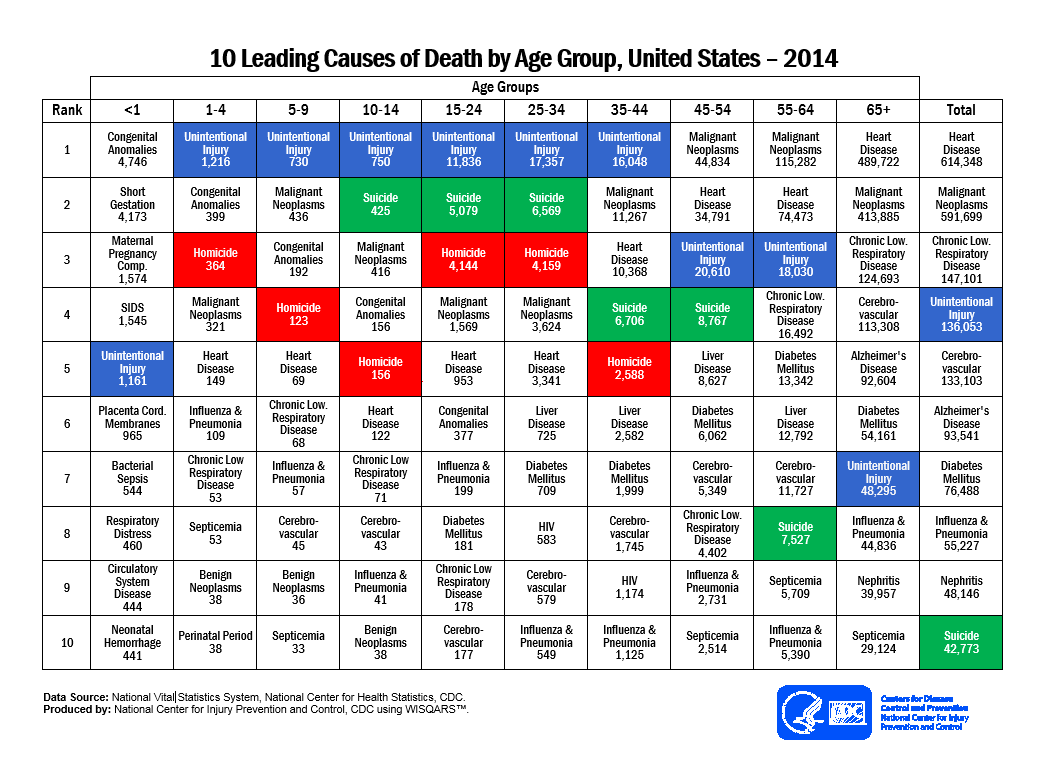
Title: Leading Causes of Death By Age Group- The American Perspective

Category: International EM

Keywords: Mortality, injuries (PubMed Search)

Posted: 4/6/2016 by Jon Mark Hirshon, MPH, MD, PhD

As noted previously, injuries cause substantial morbidity and mortality globally.  How does it vary by age group?

The following table shows that unintentional injuries are the leading cause of death for individuals 1-44 years of age. Even when they are not the leading cause of death, injuries cause substantial mortality in all age groups.


Show References


Title: Emergency Medicine Training in the US- How Competitive is it?

Category: International EM

Keywords: Match, training, emergency medicine, residency (PubMed Search)

Posted: 3/30/2016 by Jon Mark Hirshon, MPH, MD, PhD (Updated: 4/6/2016)

Emergency medicine remains a relatively young and developing specialty in most parts of the world.  However, it is growing in popularity, especially in the U.S.  How competitive is it currently?


For the recent 2016 Match, there were 2476 applicants for 1895 categorical emergency medicine positions from 174 programs.


Bottom Line: Emergency medicine remains a highly desired and competitive specialty in the U.S.


Congratulations to all the incoming interns for the 2016-2017 year!


Title: Cutaneous Larva Migrans- What is it?

Category: Infectious Disease

Keywords: Rash, Cutaneous larva migrans, nematode, tropics (PubMed Search)

Posted: 3/16/2016 by Jon Mark Hirshon, MPH, MD, PhD

Cutaneous larva migrans (CLM) is an acquired dermatosis


Clinical manifestations:


Treatment:


Bottom Line:

Show References

Attachments


Title: What Patients are at High Risk for Flu-Related Complications?

Category: International EM

Keywords: Infectious diseases, influenza (PubMed Search)

Posted: 3/2/2016 by Jon Mark Hirshon, MPH, MD, PhD

While the flu season this year has been mild, it is still important to recognize which patients are at high risk for flu-related complications:


During the influenza season, when admitting a patient who 1) has respiratory symptoms and 2) is at high risk for influenza complications, consider testing them for influenza.

Show References


Title: Criteria for Dengue Hemorrhagic Fever

Category: International EM

Keywords: Dengue, Hemorrhagic Fever, arbovirus, flavivirus (PubMed Search)

Posted: 2/18/2016 by Jon Mark Hirshon, MPH, MD, PhD

What are the criteria for dengue hemorrhagic fever?

Show References


Title: Zika Virus- An International Public Health Emergency

Category: International EM

Keywords: Zika virus, public health emergency, infectious disease, WHO (PubMed Search)

Posted: 2/3/2016 by Jon Mark Hirshon, MPH, MD, PhD

On February 1st, the World Health Organization declared that Zika was an international public health emergency.  As noted in the Pearl from January 20th, 2016, Zika is a mosquito-borne RNA flavivirus that is usually asymptomatic.  However, congenital malformations have been seen in pregnant women infected with Zika.

While it is clear that the decision to declare an international public health is a judgement call, what are the criteria for considering this declaration?

Per the WHO, the term Public Health Emergency of International Concern is defined in the IHR (2005) as “an extraordinary event which is determined, as provided in these Regulations:

·         to constitute a public health risk to other States through the international spread of disease; and

·         to potentially require a coordinated international response”. This definition implies a situation that: is serious, unusual or unexpected; carries implications for public health beyond the affected State’s national border; and may require immediate international action.

The responsibility of determining whether an event is within this category lies with the WHO Director-General and requires the convening of a committee of experts – the IHR Emergency Committee.

For Zika, the sequalae of concern are the clusters of microcephaly and Guillain-Barré syndrome suspected to have resulted from Zika infection.

Show References


Title: What is Zika?

Category: International EM

Keywords: Zika, flavivirus, travel, infectious diseases (PubMed Search)

Posted: 1/20/2016 by Jon Mark Hirshon, MPH, MD, PhD

Zika virus is a mosquito-borne flavivirus. 


While outbreaks have been previously reported in Africa, Asia and the islands of the Pacific, it was first reported in the Western Hemisphere in May 2015. 


Clinical Disease:


Diagnosis and Treatment


Prevention

Show References


Title: Burns- The International Burden

Category: International EM

Keywords: Burns, low- and middle-income countries, disease burden (PubMed Search)

Posted: 1/6/2016 by Jon Mark Hirshon, MPH, MD, PhD (Updated: 1/16/2016)

Every year approximately 265,000 people die from burns

·      The vast majority occur in low- and middle-income countries

o   The rate of child death from burns is 7 times worse in low- and middle-income countries compared to high income countries

·      Almost half of all fatal burns occur in the WHO South-East Asia Region


Non-fatal burns are a leading cause of global morbidity

·      In 2004, almost 11 million individuals worldwide were burned badly enough to require medical attention


Unlike many other unintentional injuries, burns occur:

·      Mainly in the home and workplace

o   Women are at greater risk secondary to open fire cooking

·      Approximately equally among men and women

o   Most other injuries occur more frequently in men


Most burns are preventable.  Developing an effective burn prevention plan involving multiple sectors is important.  Per the WHO, the plan should be broad with efforts to:


·      improve awareness

·      develop and enforce effective policy

·      describe burden and identify risk factors

·      set research priorities with promotion of promising interventions

·      provide burn prevention programmes

·      strengthen burn care

·      strengthen capacities to carry out all of the above.

Show References


Previous  |  1 |  2 |  3 |  4 |  5 |  Next